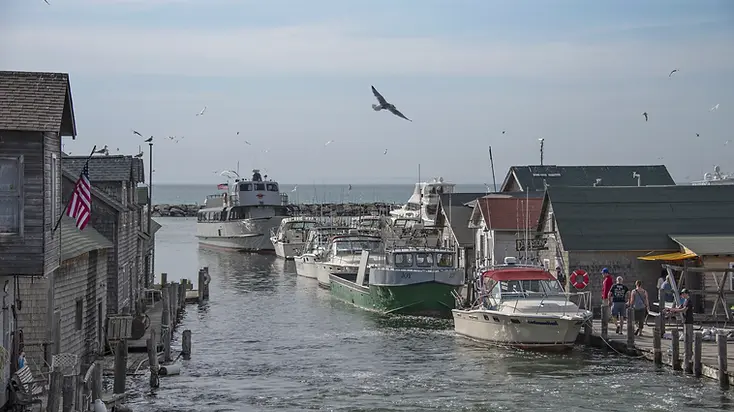
Fishtown is part of Leland, a community on Michigan's Leelanau Peninsula. It sits along the lower Leland River near the harbor and Lake Michigan. It is not a separate town or a purpose-built historical theme park.
The waterfront contains historic fishing shanties, smokehouses, docks, and vessels associated with the area's fishing industry. Some of the old buildings now hold small businesses, while the site retains an active commercial fishing identity.
A visit is an opportunity to see how a Great Lakes working waterfront can remain part of everyday community life, rather than becoming only a memory.
The story of fishing in Leland reaches back long before the present-day shanties. Indigenous people lived and fished here before white settlers arrived in the early 1850s. The fishing district later acquired the name “Fishtown” in the 1940s. That history deserves acknowledgment rather than treating the commercial village as the beginning of fishing on this shoreline.
As commercial fishing developed, the waterfront needed practical buildings. Shanties provided places to store equipment, repair nets, handle fish, and support work that depended on the lake and the weather. They were working structures, not buildings designed to look charming for visitors.
Over the decades, fishing practices and the local economy changed. Some buildings took on new roles as shops and visitor businesses. Yet the surviving structures and docks still communicate something essential about the place's origins.
This is why the word preservation matters here. The aim is not to freeze Fishtown at one imaginary moment in history. It is to keep a historic working place recognizable, useful, and accessible.
Why Fishtown's Preservation Story Matters
The Fishtown Preservation Society was formed to protect the waterfront's historical character and continued public access. In February 2007, the nonprofit acquired a quarter-acre parcel with eight shanties, two smokehouses, about 200 feet of docks, other structures, and the fish tugs Joy and Janice Sue with related licenses and equipment. In 2016, it acquired two neighboring shanties and their lots on the south side of the river. The society owns key historic properties, not every building in the broader Fishtown area.
The Fishtown Historic District was listed on the National Register of Historic Places in January 2022. That recognition is distinct from the broader Leland Historic District, listed in 1975.
Keeping these buildings standing is not simple. They sit beside moving water, and changing lake levels and aging foundations have created significant challenges. Starting in 2020, preservation crews lifted three threatened shanties, installed new support piles, and returned the structures to position. Other work addressed foundations, siding, windows, and docks. Michigan's State Historic Preservation Office recognized this collaborative preservation effort with a 2022 Governor's Award.
The lesson is bigger than one fishing village: historic places survive because people decide they are worth maintaining, even when doing so is difficult and expensive.
Take time to notice the buildings themselves. Their shapes, materials, and placement beside the river reflect practical work that once happened inside them. Many are now small shops, but their original purposes help explain why they stand where they do.
The waterfront's relationship with the water is the central story. Look for the fishing tugs Joy and Janice Sue and the spaces where gear, fish, and people have moved between shore and lake. The preservation society describes these as operational fishing vessels, not static museum exhibits. Their activity is not guaranteed during any particular visit. This is an active environment, so stay in public areas and respect working operations.
Fishtown is not merely a backdrop for photographs. Businesses such as Carlson's Fishery connect the waterfront to generations of commercial fishing. Buying local products can be one way to support the community, but business offerings and hours should be checked before a visit.
The lower Leland River provides a natural thread through the village toward Lake Michigan. Following that geography makes the history easier to understand: fishing boats, waterfront buildings, and the harbor all exist here for a reason.
Fishtown is a good place to explore on foot, with time to look closely rather than rush from one stop to the next.
The Fishtown Preservation Society says the waterfront is publicly accessible year-round, but individual shops and services operate on their own schedules. The waterfront is a working area, not a designated swimming spot: the society specifically warns against swimming in the river because of swift current and working boats. Its published business guidance describes most shops as generally operating from early May through late October, with variations. A winter visit may offer a very different experience from a summer afternoon.
Parking near the harbor is limited and may fill quickly; some spaces are metered. The preservation society also identifies parking along nearby streets. Follow posted parking rules and avoid blocking local access.
If you are planning around a specific shop, fishing-related activity, ferry, or charter, check directly with the operator. For example, Carlson's Fishery is listed by the preservation society as a multi-generation business selling fresh and smoked fish, but availability is subject to its own operations. Access, schedules, fees, and weather can change.
For current information, use the Fishtown Preservation Society website and its directions and parking guidance.
Start by observing the shanties and docks from public areas. Look for the ways their working functions shaped the buildings, then follow the river toward the harbor to see why this location supported fishing. If shops are open, consider stopping at a local business and learning about the fishery rather than treating the village only as a photo backdrop. Give yourself room to wander; this is a suggested sequence, not a fixed-duration tour or an assertion that every building is open to enter.
For families, one useful question is: What would it take to keep a place like this working for another generation? The answer connects history to the practical realities of maintenance, livelihoods, weather and community support.
There is an easy temptation to judge a place like Fishtown only by how it looks in a photograph. The weathered wood and boats are memorable, but they are not the whole reason to go.
The more interesting story is the relationship between work, community, and place. Generations depended on this waterfront. As the industry changed, local people found ways to protect its character without erasing the fact that fishing still matters here.
That is a story worth sharing with younger travelers, too. A walk through Fishtown can open conversations about the Great Lakes, how communities make a living, and what it takes to preserve something meaningful for the next generation.
You do not need a packed itinerary to appreciate it. Allow yourself time to notice the details, ask thoughtful questions, and remember that these are not just old buildings. They are part of a living Michigan story.
Fishtown is in Leland, Michigan, on the Leelanau Peninsula. The waterfront is generally accessible to visitors, but shop and operator hours vary by season. Check current parking conditions and any activity-specific details before setting out.
If you value Michigan history, Great Lakes landscapes, and places where a community's past remains visible in the present, Fishtown deserves a place on your travel list.
Research note: This is a destination guide, not a first-person account of an owner-confirmed visit. No personal experiences, conversations, photographs, current admission prices, ferry departures or business opening hours have been invented.
Cover photograph: Richard Hurd, June 8, 2019, licensed under CC BY 2.0. The original image is reproduced without an editorial crop; the page may crop its display responsively.