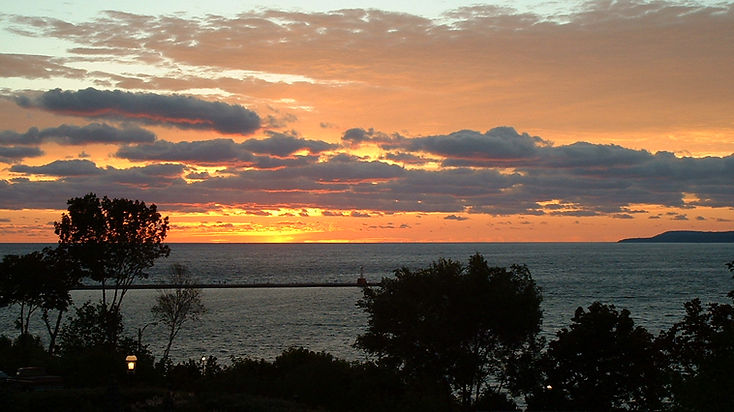
The underwater crucifix lies off the shoreline of Petoskey, near the city's waterfront and breakwall.
Carved from white Italian marble, the crucifix measures approximately 11 feet tall, with a figure of Jesus measuring about 5 feet, 5 inches. It weighs nearly a ton.
It was placed in Little Traverse Bay in 1962 and later moved to a shallower location.
The Petoskey Area Visitors Bureau identifies its present location as approximately 800 feet offshore in about 21 feet of water.
Unlike the many ships that accidentally sank in Michigan's Great Lakes, this memorial was intentionally placed beneath the surface.
And its origins begin far from Petoskey.
Long before the crucifix was submerged in Lake Michigan, it was intended for a small community in Michigan's Thumb region.
In 1956, 15-year-old Gerald Schipinski died in an accidental shooting on his family's farm near Rapson, Michigan.
His grieving parents commissioned a marble crucifix from Italy to honor his memory.
The sculpture was intended for their local Catholic community. But during its journey from Italy, it was damaged. When it arrived, the family declined the broken memorial.
The crucifix might have disappeared into storage and been forgotten.
Instead, it found an entirely different purpose.
The Wyandotte-based Superior Marine Divers Club learned about the damaged sculpture and acquired it through an insurance sale.
The divers repaired the marble figure and began planning something unusual: placing the crucifix beneath the waters of Lake Michigan as a memorial.
Its original purpose was to honor Charles Raymond, a Southgate diver who had drowned in Torch Lake.
The dedication eventually expanded to remember others who lost their lives in the water.
What began as one family's remembrance became a monument to many.
On August 12, 1962, the Superior Marine Divers Club carried out its remarkable plan.
With assistance from the U.S. Coast Guard icebreaker Sundew, the marble crucifix was lowered into Little Traverse Bay.
The original location was farther offshore and deeper than the monument's present resting place: the crucifix was first placed about 1,200 feet off the Petoskey breakwall.
The installation attracted public attention and helped establish the underwater crucifix as an unusual part of northern Michigan's maritime history.
Over time, the original placement proved difficult to maintain and visit.
About twenty years after the installation, the memorial was raised from the water and a new base was built in the Petoskey marina. It was then returned to the bay in shallower water, closer to shore, in the early 1980s.
Today, the memorial rests in approximately 20–22 feet of water, where it continues to attract interest from divers, historians, and visitors.
For years, the crucifix was primarily an attraction for scuba divers.
Then, in the 1980s, a local diver named Dennis Jessick helped introduce a new way for people to experience it.
Why not allow the public to view the memorial through the frozen surface of Lake Michigan?
In 1986, the first organized winter viewing took place.
When ice conditions were sufficiently stable, volunteers prepared a viewing area, opened a section of the ice above the crucifix, and placed lights underwater.
Visitors could walk to the organized viewing area and look down through the opening.
The marble figure, illuminated beneath the ice, created a striking scene.
The tradition became a special part of Petoskey's winter calendar, attracting visitors from across Michigan and beyond.
But there is an important limitation: the viewing is never guaranteed.
It depends on safe ice thickness, weather, organizer approval, and local conditions. Several winters have passed without an event.
Yes, the memorial remains a recognized Petoskey attraction, but there are two very different ways to experience it.
For non-divers, the most unusual opportunity is a supervised public viewing when local organizers determine that conditions permit.
Historically, these events have taken place in late February or early March.
Visitors have been able to see the illuminated crucifix through an opening in the ice. The viewing has traditionally been free.
However, do not walk onto Little Traverse Bay expecting to find an open viewing area.
Ice conditions can be dangerous, and an event may not take place in a given year.
Only attend an officially announced viewing, follow organizers' instructions, and remain within approved public areas.
The Petoskey Area Visitors Bureau is a useful starting point for event information and historical background.
The crucifix is also a known scuba diving attraction.
At approximately 20–22 feet, its depth is within normal recreational scuba limits.
But depth alone does not make a dive easy or appropriate.
Little Traverse Bay is part of Lake Michigan, and divers must account for cold water, variable visibility, currents, weather, surface traffic, and access restrictions.
Before attempting a dive, confirm current access with a knowledgeable local dive operator, plan with a qualified buddy, and use equipment appropriate for Great Lakes conditions.
Do not assume that the closest point on shore is a safe or authorized entry location.
Ice diving is a separate overhead environment requiring specialized training, equipment, surface support, and procedures.
An organized winter viewing is not an invitation to attempt an ice dive.
Michigan's Great Lakes are filled with extraordinary underwater history.
Wooden schooners, steamships, tugboats, and freighters tell stories of storms, commerce, navigation, and tragedy.
But the underwater crucifix tells a different kind of story.
It wasn't lost in a storm. It wasn't carrying cargo. And it wasn't an accidental casualty of the Great Lakes.
People deliberately placed it beneath the water.
It was created as a memorial, transformed through an unexpected chain of events, and preserved by generations of Michigan divers.
The sculpture also connects two different kinds of loss: the death of a young boy in rural Michigan and the lives of people lost in the state's waters.
Its religious imagery is unmistakable, but its commemorative purpose has extended beyond any one family or community.
That combination of faith, remembrance, maritime history, and diving culture makes the crucifix unlike almost anything else in Michigan.
The People Who Kept the Story Alive
One of the most remarkable parts of this history is that the memorial's story didn't end when it was lowered into the bay.
Divers continued visiting and caring for the crucifix.
Local volunteers helped maintain the tradition of public winter viewings.
Dennis Jessick played an especially important role in preserving its history and organizing public access.
In a 2023 episode of Points North, Interlochen Public Radio explored the crucifix's origins and interviewed people connected to its history, including members of the Schipinski family.
Their account demonstrates how an unusual underwater attraction became a meaningful link between families, divers, and a northern Michigan community.
Even if you can't visit the crucifix itself, Petoskey is worth exploring.
The town sits along Little Traverse Bay, with a waterfront, parks, downtown shopping, and access to some of northern Michigan's most beautiful shoreline scenery.
A visit can easily include a walk along Bayfront Park, time in downtown Petoskey, and an exploration of the wider Little Traverse Bay area.
For scuba divers, the region can be part of a larger northern Michigan diving itinerary that includes Lake Charlevoix and other documented freshwater sites in our Dive Michigan shipwreck guide.
For non-divers, the crucifix's story adds an unexpected layer of history to a waterfront visit.
| Question | What to know |
|---|
| Where is it? | Little Traverse Bay, Petoskey, Michigan |
| How far offshore? | Approximately 800 feet |
| How deep? | Approximately 20–22 feet |
| How large? | Approximately 11 feet |
| When was it installed? | August 12, 1962 |
| Can non-divers see it? | At organized winter viewings when conditions permit |
| Is there an admission fee? | Winter public viewings have historically been free |
| Can you scuba dive there? | Known dive site; verify current access and conditions locally |
| Is there a guaranteed annual viewing? | No |
Yes. An approximately 11-foot white marble crucifix depicting Jesus Christ rests beneath Little Traverse Bay near Petoskey.
A Michigan diving club installed it in 1962 to honor a diver who drowned. Its memorial purpose later expanded to commemorate people who lost their lives in the water.
It is currently reported at approximately 20–22 feet below the surface.
Occasionally. Organizers have held winter viewings through an opening in the ice when conditions are safe enough. These events are not guaranteed.
The monument is offshore, but there is no guarantee it will be visible from a kayak. Water clarity, surface conditions, and the precise location matter. Do not treat the approximate offshore distance as a navigational route.
It is a submerged memorial, not a staffed attraction with regular operating hours. Dive access and public viewing opportunities depend on conditions and local arrangements.
From the Petoskey shoreline, Little Traverse Bay looks like another beautiful stretch of northern Michigan waterfront.
But beneath the surface lies a remarkable piece of history.
A marble crucifix commissioned by grieving parents in the 1950s became an underwater memorial in 1962.
Generations of divers cared for it, and volunteers later created a tradition that allowed the public to experience it through the winter ice.
It's a story about loss, faith, ingenuity, and remembrance.
And it's a reminder that some of Michigan's most fascinating destinations aren't found along a hiking trail or scenic highway.
Sometimes, they're waiting quietly beneath the water.