The Shipwrecks Beneath Lake Huron
Imagine looking down through the clear water of Lake Huron and seeing the wooden ribs of a nineteenth-century schooner resting beneath your boat.
Its masts are gone. Its cargo is long forgotten. But parts of its hull remain where the vessel came to rest generations ago.
Now imagine that this is only one of dozens of historic shipwrecks scattered across a vast underwater landscape.
Welcome to Thunder Bay National Marine Sanctuary.
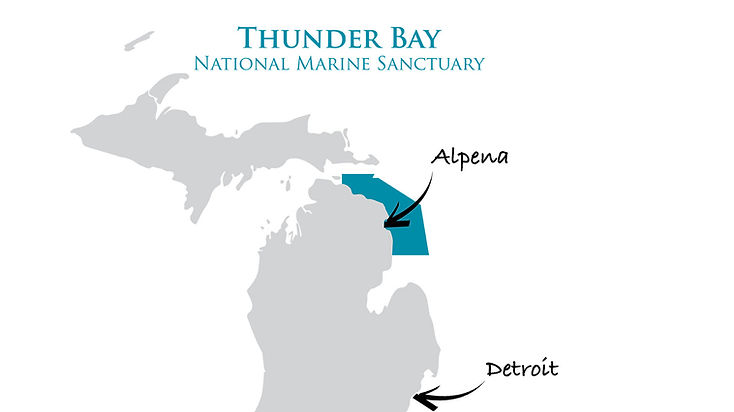
Located off Michigan's northeastern Lower Peninsula near Alpena, this protected region of Lake Huron is one of the most remarkable maritime heritage destinations in the United States.
It is often called Shipwreck Alley.
The name is appropriate.
For generations, ships navigating these waters encountered sudden storms, thick fog, rocky shoals, dangerous currents, and the hazards of crowded shipping routes.
Some vessels found shelter in Thunder Bay.
Others never completed their journeys.
Today, the sanctuary protects a nationally significant collection of shipwrecks, ranging from wooden sailing vessels to large steel freighters.
And unlike many famous shipwrecks that rest hundreds of feet below the surface, several of Thunder Bay's historic vessels lie in relatively shallow water.
That creates unusual opportunities to explore Michigan's underwater history through scuba diving, snorkeling, kayaking, glass-bottom boat tours, and museum exhibits.
You don't need to be a scuba diver to appreciate this place.
You just need an interest in history, adventure, and the remarkable stories hidden beneath the Great Lakes.
What Is Thunder Bay National Marine Sanctuary?
Thunder Bay National Marine Sanctuary is a federally designated marine protected area in northwestern Lake Huron.
It is jointly managed by the National Oceanic and Atmospheric Administration (NOAA) and the State of Michigan.
The sanctuary was designated in October 2000 and significantly expanded in September 2014.
Today, it encompasses approximately 4,300 square miles of Lake Huron.
Its boundaries extend along a substantial stretch of Michigan's northeastern shoreline.
Within these waters, NOAA identifies approximately 100 discovered shipwrecks, with evidence suggesting that many additional wrecks remain undiscovered.
The sanctuary is not simply a collection of dive sites.
It is a protected historical landscape.
Each vessel represents a chapter in the development of Great Lakes commerce, transportation, engineering, and settlement.
Wooden schooners carried agricultural products and bulk freight.
Steam-powered vessels transported passengers and industrial cargo.
Steel freighters reflected the growth of manufacturing and modern shipping.
Together, the wrecks reveal how life and commerce evolved around the Great Lakes.
And the cold freshwater of Lake Huron has helped preserve many of these historic remains.
Why Is It Called Shipwreck Alley?
The nickname comes from the extraordinary number of maritime disasters associated with the region.
Thunder Bay sits near major Great Lakes shipping routes.
For vessels traveling along Lake Huron, the surrounding waters could offer shelter from storms—but also present serious hazards.
Fog could conceal approaching vessels or dangerous shorelines.
Unexpected gales could overwhelm sailing ships.
Rocky shoals could tear open a hull.
And collisions were a persistent danger on busy shipping routes.
During the nineteenth and early twentieth centuries, ships had fewer navigational technologies than modern vessels.
Captains relied on charts, compasses, visual landmarks, experience, and increasingly sophisticated but imperfect instruments.
When conditions deteriorated, even experienced crews could find themselves in trouble.
The result was a remarkable concentration of wrecks.
Some ships sank in deep water.
Others were driven onto reefs or shorelines.
Still others burned, collided, or foundered during severe weather.
Today, these vessels form an underwater record of the challenges faced by generations of Great Lakes sailors.
The Ships That Made Michigan's Maritime History
To understand Thunder Bay, it helps to understand the vessels that once traveled these waters.
Wooden schooners
During the nineteenth century, sailing schooners transported cargo across the Great Lakes.
They carried salt, grain, lumber, coal, and other goods between growing communities.
Their wooden hulls and sailing rigs represented an era when wind remained an essential source of maritime power.
Many were eventually lost to storms, groundings, and collisions.
Steam-powered vessels
Steam technology transformed Great Lakes shipping.
Steamers could travel more predictably than sailing vessels, although they still faced severe weather and mechanical hazards.
Some early steamships used side-mounted paddle wheels.
Later vessels relied on screw propellers.
The remains of boilers, engines, shafts, and propellers provide important evidence of this technological transition.
Steel freighters
As industrial demand increased, shipbuilders constructed larger vessels with iron and steel hulls.
These freighters transported increasingly heavy cargoes.
They also reflected the growing importance of the Great Lakes to American industry.
Several Thunder Bay wrecks preserve evidence of this period of rapid technological change.
Historic Shipwrecks You Can Explore
One of the sanctuary's greatest attractions is the variety of its shipwreck sites.
Some are shallow enough to be observed from the surface under suitable conditions.
Others require scuba certification, specialized training, and careful planning.
The following vessels illustrate the diversity of the sanctuary.
1. Portland — A Schooner in Shallow Water
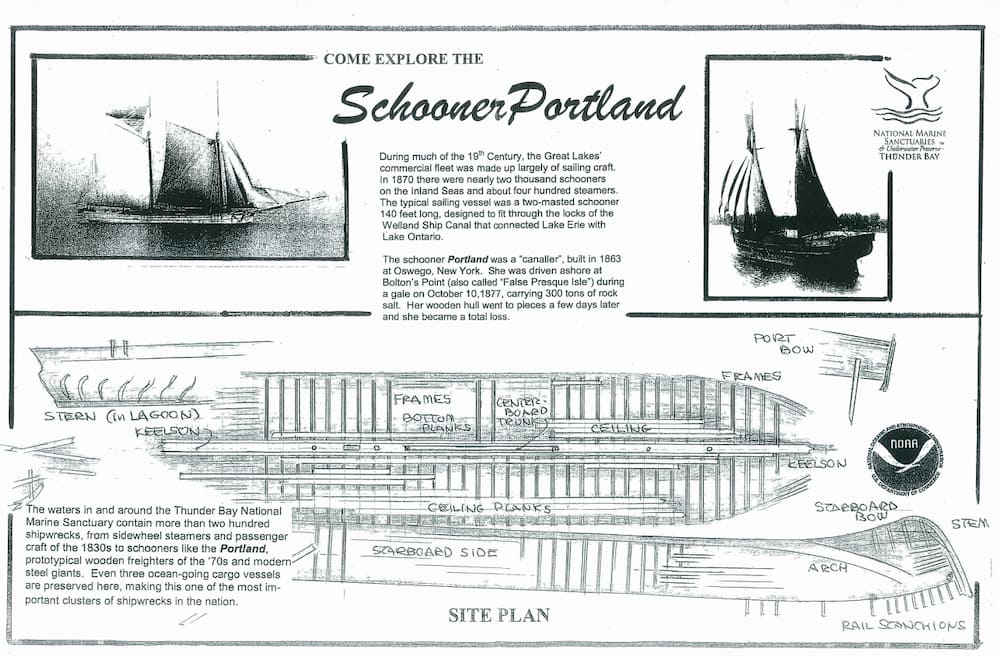
The Portland is among the sanctuary's most accessible historic wrecks.
Built in 1863, this wooden two-masted schooner carried cargo across the Great Lakes.
In October 1877, the vessel encountered a severe storm while transporting salt.
The ship was driven ashore and broken apart by waves and rocks.
Today, the wreck lies in approximately six feet of water.
Its remains offer a fascinating glimpse into nineteenth-century wooden ship construction.
For visitors interested in shallow-water shipwrecks, Portland is an excellent example of the history preserved beneath Lake Huron.
However, shallow depth does not automatically mean safe access.
Weather, wave action, visibility, water temperature, currents, and lawful shoreline access must all be considered.
Visitors should use NOAA's current site information before attempting any independent excursion.
2. Monohansett — A Steam Barge Destroyed by Fire
The Monohansett tells a different kind of shipwreck story.
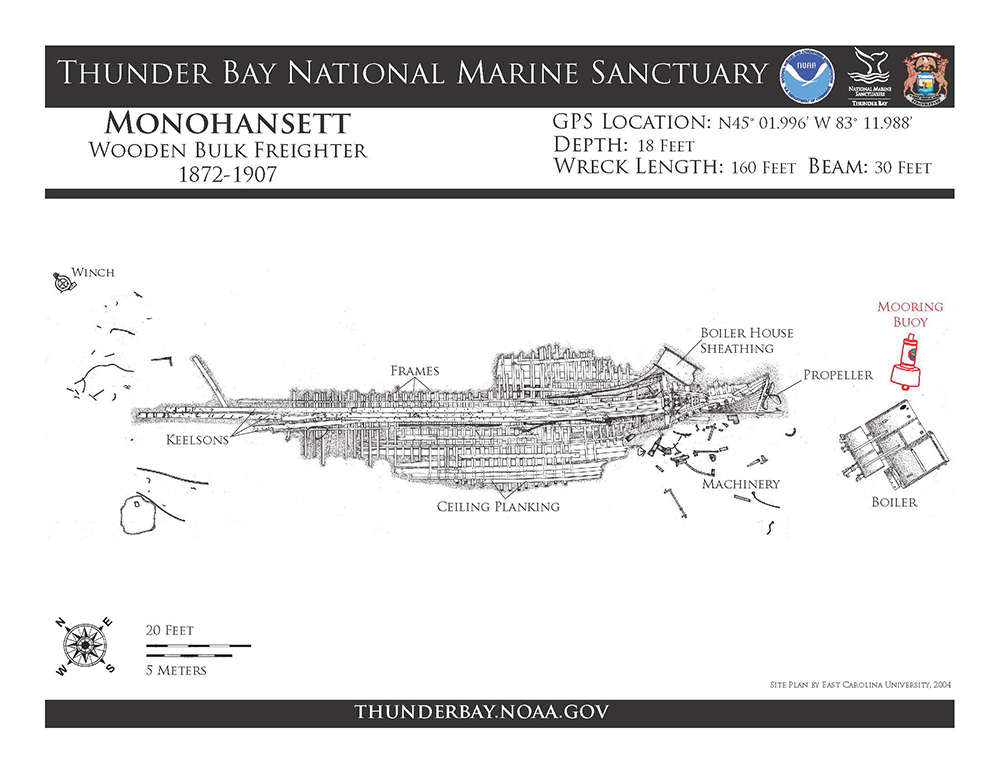
Built in 1872, this wooden steam barge carried bulk cargo on the Great Lakes.
On November 23, 1907, the vessel sheltered near Thunder Bay Island during gale-force weather.
A fire broke out aboard the ship.
The blaze spread rapidly through the wooden vessel, which was carrying coal.
The crew abandoned the burning barge.
Fortunately, lifesavers from the Thunder Bay Island Life-Saving Station rescued the crew.
Today, the Monohansett rests in approximately 18 feet of water.
Its remains include parts of the wooden hull, machinery, boilers, and other features associated with steam-powered shipping.
It is one of the sanctuary's better-known shallow wrecks.
Divers and snorkelers may be able to explore it under appropriate conditions, while paddlers and glass-bottom boat passengers can sometimes observe the site from above.
3. Grecian — An Early Steel Freighter
The Grecian represents a later chapter in Great Lakes maritime history.
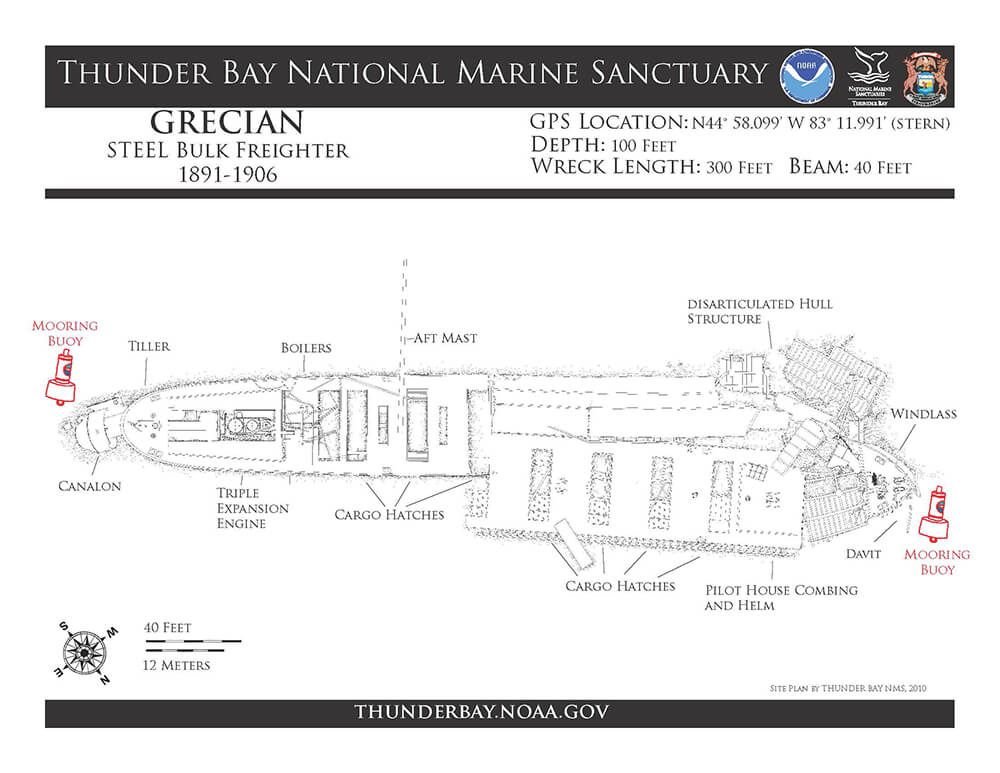
Launched in 1891, the steel-hulled freighter was built during a period of rapid industrial growth.
In June 1906, the ship struck a reef and sustained damage.
While being towed for repairs, the vessel flooded and sank near Thunder Bay.
Today, the wreck rests in approximately 100 feet of water.
Its deck and upper structures are shallower, but the site remains an advanced undertaking compared with the sanctuary's shallow wrecks.
The wreck includes substantial remains of the ship's bow and stern, along with machinery and structural features.
For appropriately trained divers, Grecian offers a remarkable opportunity to examine early steel freighter construction.
It is also listed on the National Register of Historic Places.
Other Wrecks Worth Discovering
Thunder Bay contains many more historic shipwrecks, including vessels such as Albany, Lucinda Van Valkenburg, W.P. Thew, and E.B. Allen.
Each has a distinct history, depth, condition, and accessibility profile.
NOAA maintains an official shipwreck directory with historical descriptions, archaeological documentation, and site information.
For anyone planning to explore a particular wreck, that directory should be the starting point.
Never assume that two shipwrecks offer comparable diving or paddling conditions simply because they are located within the same sanctuary.
Can You Scuba Dive in Thunder Bay?
Yes.
Thunder Bay is an important Great Lakes scuba diving destination.
Its shipwrecks span a wide range of depths, conditions, and experience requirements.
Some shallow sites may be appropriate for divers with suitable training and local knowledge.
Deeper wrecks require additional experience and careful planning.
Cold water is a major consideration.
Lake Huron can remain dangerously cold even during warm summer weather.
Divers should evaluate exposure protection, visibility, depth, boat traffic, emergency procedures, and appropriate certification before entering the water.
Using a qualified local dive operator is a sensible approach, particularly for visitors unfamiliar with Great Lakes wreck diving.
The sanctuary also maintains seasonal mooring buoys at numerous shipwreck sites.
These help visiting boats secure themselves without dropping anchors onto historic wreckage.
Mooring availability should always be checked before departure.
No article, map, or historical description should replace current marine conditions, professional training, or a proper dive plan.
Snorkeling and Shallow-Water Shipwrecks
You don't necessarily need scuba equipment to appreciate Thunder Bay's underwater history.
Some wrecks rest in shallow water.
Under suitable conditions, their outlines and surviving structures may be visible from the surface.
Snorkeling can offer a fascinating perspective on historic vessels without requiring a deep dive.
But the Great Lakes demand respect.
Cold water, changing weather, waves, limited visibility, and boat traffic can create hazards even at shallow sites.
A life jacket or other appropriate flotation, a suitable exposure suit, and a conservative plan are important.
Visitors should never climb on wreckage, remove artifacts, or disturb historic structures.
These vessels are protected cultural resources.
Their value depends on preserving them for future generations.
Kayaking Over Michigan's Shipwrecks
Kayaking offers another way to experience the sanctuary.
On a calm day, the surface of Lake Huron may reveal glimpses of submerged wooden structures and other historic remains.
Some shallow shipwrecks can be viewed from a kayak or paddleboard when visibility and conditions permit.
It can be a remarkable experience to look beneath your boat and recognize the outline of a vessel that sank more than a century ago.
However, paddling on Lake Huron is very different from paddling a small inland lake.
Conditions can change rapidly.
Wind can build waves and make returning to shore difficult.
Cold-water immersion is a serious risk.
Paddlers should use appropriate flotation and exposure protection, check marine forecasts, and choose routes suited to their ability.
The presence of a shallow wreck does not guarantee a safe or lawful launch point.
Whenever possible, explore with experienced local guides.
Glass-Bottom Boat Tours: Shipwrecks Without Getting Wet
For many visitors, a glass-bottom boat tour may be the most approachable way to experience Thunder Bay's shipwrecks.
These excursions allow passengers to observe historic wrecks through viewing panels in the boat.
Guides can explain the history of the vessels and the conditions that led to their loss.
For families, history enthusiasts, and travelers who don't scuba dive, this can be one of the most memorable ways to explore Shipwreck Alley.
Tours are dependent on seasonal schedules, weather, visibility, vessel operations, and availability.
The number of wrecks visible on any particular trip can vary.
Visitors should confirm current operations and booking details through the official tour provider rather than assuming departures are available every day.
A boat tour can also pair naturally with a visit to the Great Lakes Maritime Heritage Center in downtown Alpena.
Visit the Great Lakes Maritime Heritage Center
One of the best places to begin your Thunder Bay experience is the Great Lakes Maritime Heritage Center.
Located in Alpena along the Thunder Bay River, this NOAA visitor center introduces the history, science, and archaeology of the sanctuary.
The center features more than 10,000 square feet of exhibits.
Visitors can experience an immersive representation of a Lake Huron storm, explore shipwreck-related displays, and learn about the people and vessels connected to the region.
It is an especially useful destination for families and visitors who want to understand the shipwrecks without entering the water.
Admission is free.
The center is open year-round, although schedules can change for events and other circumstances.
Address: 500 W. Fletcher Street, Alpena, Michigan.
Before visiting, confirm current hours and exhibit availability on NOAA's official website.
Alpena: The Gateway to Shipwreck Alley
Thunder Bay is more than an underwater destination.
The city of Alpena provides an excellent starting point for exploring northeastern Michigan's maritime heritage.
Visitors can combine the sanctuary with waterfront walks, local museums, historic sites, and scenic Lake Huron shoreline destinations.
Alpena is also connected to the broader US-23 Heritage Route along Michigan's Sunrise Coast.
This scenic corridor offers opportunities to discover lighthouses, beaches, small towns, and coastal landscapes.
For travelers who enjoy combining history with outdoor recreation, the area offers much more than a single attraction.
A visit to Thunder Bay can become the centerpiece of a longer northeastern Michigan trip.
How to Plan Your Visit
Best time to go
Summer and early fall are generally attractive seasons for sightseeing and outdoor recreation.
However, lake conditions—not simply the calendar—should determine whether boating, snorkeling, kayaking, or diving is appropriate.
Museum visits can provide a valuable alternative when conditions are unsuitable for water activities.
Start at the visitor center
The Great Lakes Maritime Heritage Center provides historical context and information about the sanctuary.
It's a logical first stop for travelers unfamiliar with the region.
Choose your experience
Families and casual visitors may prefer museum exhibits and glass-bottom boat tours.
Paddlers can investigate guided shallow-water experiences.
Certified divers can research appropriate wreck sites and charter operators.
Check current conditions
Consult current marine forecasts, weather advisories, water temperature, visibility, and operator guidance.
Never rely solely on an article's general seasonal recommendations.
Protect the wrecks
Look, photograph, and learn—but leave the historic structures and artifacts undisturbed.
Avoid anchoring on wreckage and follow applicable sanctuary and state regulations.
Why Shipwreck Preservation Matters
The wrecks of Thunder Bay are more than tourist attractions.
They are historical evidence.
A wooden hull can reveal how nineteenth-century vessels were constructed.
An engine or propeller can demonstrate changes in maritime technology.
Cargo remains can reveal what communities traded and consumed.
Archaeologists use mapping, photography, underwater surveys, and other techniques to document these sites.
Preservation also helps protect the stories of the sailors and passengers who traveled aboard the vessels.
Once a wreck is damaged or its artifacts are removed without documentation, valuable historical information can be lost.
Thunder Bay National Marine Sanctuary helps protect these resources while creating opportunities for public education and responsible recreation.
Thunder Bay and the Larger Story of Michigan Shipwrecks
Michigan's maritime history stretches across all five Great Lakes.
Lake Superior is famous for the Edmund Fitzgerald and other deep-water tragedies.
Lake Michigan contains remarkable historic wrecks, including vessels accessible to divers and some visible from the surface.
Lake Huron's Thunder Bay region offers an especially concentrated collection of protected maritime sites.
Together, these destinations tell the story of the Great Lakes as highways of commerce, places of danger, and repositories of history.
Thunder Bay is an excellent starting point for anyone who wants to understand that larger story.
Frequently Asked Questions
Where is Thunder Bay National Marine Sanctuary?
It is located in northwestern Lake Huron off Michigan's northeastern Lower Peninsula, with Alpena serving as a principal visitor gateway.
Why is it called Shipwreck Alley?
The region earned its nickname because storms, fog, shoals, collisions, and other hazards caused numerous shipwrecks along important shipping routes.
How many shipwrecks are in the sanctuary?
NOAA identifies approximately 100 discovered shipwrecks and estimates that many additional sites remain to be found. Counts may change as research progresses.
Can beginners scuba dive there?
Some shallow sites may suit appropriately trained divers, but conditions and certification requirements vary. Beginners should seek qualified local guidance.
Can you see shipwrecks without scuba diving?
Yes. Depending on conditions, visitors can experience shipwreck history through glass-bottom boat tours, shallow-water viewing, snorkeling, and museum exhibits.
Is the maritime museum free?
NOAA lists free admission to the Great Lakes Maritime Heritage Center in Alpena.
Are shipwrecks protected?
Yes. Historic wrecks are protected cultural resources. Visitors should follow all applicable sanctuary and state rules and leave artifacts undisturbed.
When is the best time to visit?
Summer and early fall are popular for outdoor activities, but marine conditions and operator schedules determine actual access.
Final Thoughts: Discovering the History Beneath Lake Huron
There is something remarkable about standing beside Lake Huron and realizing that an entire chapter of Michigan history rests beneath the surface.
The shipwrecks of Thunder Bay are reminders of the people who built, operated, and traveled aboard the vessels that connected Great Lakes communities.
Some of those ships were lost to storms.
Others were victims of fire, collisions, or navigational hazards.
Today, their remains offer opportunities to learn about the past in ways that ordinary history books cannot fully capture.
Whether you're a scuba diver, a kayaker, a history enthusiast, or a family planning a Michigan road trip, Thunder Bay National Marine Sanctuary deserves a place on your Explore Michigan list.
Because sometimes the most fascinating destinations aren't on the shoreline.
They're beneath the water.