| # | Destination | Region | Approximate depth |
|---|
| 1 | Bermuda | Munising | 12–30 ft |
| 2 | Herman H. Hettler | Munising | 30–40 ft |
| 3 | Sandstone formations | Pictured Rocks | Around 20 ft at some sites |
| 4 | Monohansett | Alpena | 18 ft |
| 5 | Oscar T. Flint | Alpena | 30 ft |
| 6 | C.H. Johnson | St. Ignace | 8–25 ft |
| 7 | Historic harbor ruins | St. Ignace | Varies |
| 8 | Three Brothers | South Manitou Island | 5–45 ft |
| 9 | Francisco Morazan | South Manitou Island | 15–20 ft |
| 10 | Walter L. Frost | South Manitou Island | 10–12 ft |
| 11 | Keuka | Lake Charlevoix | Bottom around 50 ft |
| 12 | Underwater Crucifix | Petoskey | 21 ft |
| 13 | General | DeTour Passage | 15–25 ft |
| 14 | Chickamauga | Harbor Beach | 35 ft |
| 15 | Sport | Sanilac Shores | 50 ft |
These are approximate published depths, not guarantees of accessible dive profiles. Depth alone never establishes whether a site suits you: cold water, visibility, currents, boat traffic, moorings, and overhead structures all change a dive. Confirm the current conditions with a local operator, and stay within your training.
Location: Alger Underwater Preserve
Approximate depth: 12–30 feet
Experience considerations: Shallow historic wreck; cold-water and boat-diving preparation required.
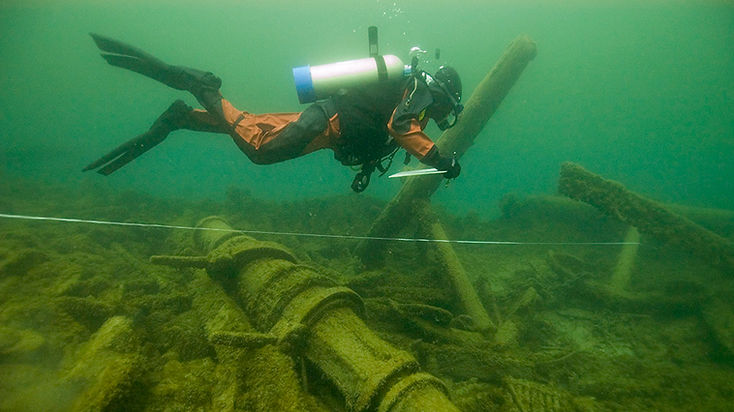
The Bermuda is one of the standout shipwrecks of the Alger Underwater Preserve near Munising.
This 130-foot wooden schooner sank in the bay off Grand Island on October 15, 1870, and rests in relatively shallow Lake Superior water. Its surviving structure provides an opportunity to observe nineteenth-century shipbuilding without descending to the extreme depths associated with many Great Lakes wrecks.
The Bermuda is also known as the Murray Bay wreck. These are two names for the same vessel.
The surrounding Munising area makes this an attractive diving destination, with Pictured Rocks, Grand Island, waterfalls, and other outdoor attractions nearby.
Why dive here: Historic wooden wreckage, comparatively shallow depth, and access to the wider Alger diving region.
Location: Alger Underwater Preserve
Approximate depth: 30–40 feet
Experience considerations: Recreational wreck-diving candidate; assess cold water, conditions, and boat access.
The Herman H. Hettler was a wooden steam-powered vessel launched in 1890. On November 23, 1926, a severe storm forced her to seek refuge in Munising Harbor, where she struck a rock reef and was lost.
Its remains lie in approximately 30–40 feet of Lake Superior water.
This wreck offers another opportunity to examine the remains of Michigan's commercial shipping history without planning an especially deep dive.
It also makes a natural companion to the Bermuda for divers exploring the Alger Underwater Preserve.
Why dive here: Historic steamship wreckage, moderate depth, and the clear freshwater diving environment around Munising.
Location: Pictured Rocks National Lakeshore, Munising
Approximate depth: Some formations around 20 feet
Experience considerations: Shallow depth does not eliminate open-water or overhead hazards.
Not every memorable dive needs a shipwreck.
Along the Pictured Rocks shoreline, portions of Lake Superior's sandstone cliffs continue beneath the water.
Erosion has created underwater formations, recesses, and dramatic rock surfaces that offer fascinating opportunities for underwater photography.
The geology makes these dives very different from exploring a wooden schooner or steel freighter.
Divers should remain outside overhead environments unless appropriately trained and equipped.
Why dive here: Underwater geology, sandstone formations, and spectacular natural scenery.
Location: Thunder Bay National Marine Sanctuary, Alpena
Approximate depth: 18 feet
Experience considerations: Shallow historic wreck; conditions and access still require assessment.
Thunder Bay is often called Shipwreck Alley, and the Monohansett is one of its fascinating shallow sites.
On the night of November 23, 1907, the wooden steam barge took shelter behind Thunder Bay Island from gale-force winds, and an overturned oil lantern started the fire that destroyed her.
Its remains rest in approximately 18 feet of water.
The relatively shallow depth makes this an interesting site for divers studying the remains of historic Great Lakes shipping disasters.
Why dive here: A documented shipwreck with a compelling history and shallow-water features.
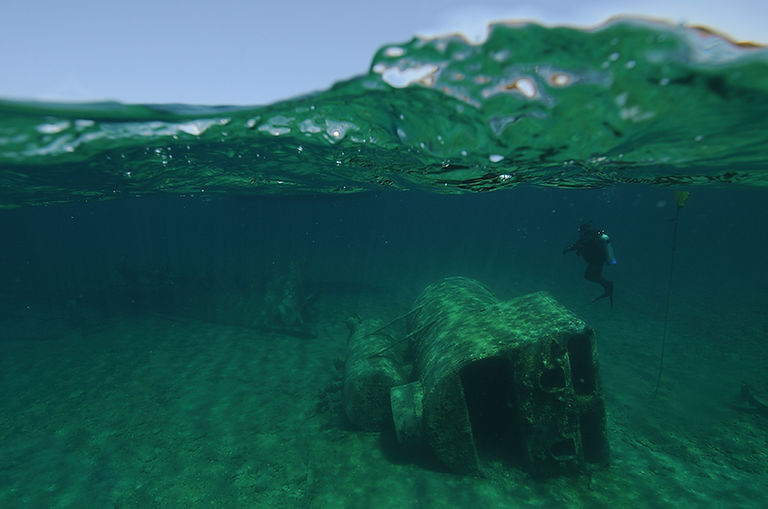
The Monohansett's boiler in Thunder Bay National Marine Sanctuary. Photo: NOAA (public domain).
Location: Thunder Bay National Marine Sanctuary, Alpena
Approximate depth: 30 feet
Experience considerations: Recreational wreck candidate, depending on diver training and conditions.
The 218-foot Oscar T. Flint was another wooden steam barge lost in the Thunder Bay region: she caught fire just after leaving Alpena in November 1909, burned to the waterline, and sank about four miles east of the Thunder Bay River mouth.
The sanctuary lists the wreck at about 30 feet (some dive guides cite 33), which provides an opportunity to explore the remains of a vessel within one of Michigan's most important maritime heritage areas.
Thunder Bay's concentration of wrecks makes Alpena an attractive base for planning multiple dives.
Why dive here: Historic shipwreck exploration in Michigan's famous Shipwreck Alley.
Location: Near St. Ignace
Approximate depth: 8–25 feet
Experience considerations: Shallow wreckage; verify current shore access and conditions.
The 137-foot C.H. Johnson was a three-masted wooden schooner built in 1870. On September 23, 1895, her anchors failed while she sheltered behind St. Helena Island in a gale, and she was driven ashore at Gros Cap, west of St. Ignace.
She had been carrying large sandstone blocks from Jacobsville, near the Keweenaw Peninsula, for a bank building in Chicago. Around 67 of those blocks still survive on the site, protecting sections of hull and frame beneath the cargo area.
Fish often shelter around the stone blocks, creating an interesting combination of maritime history and aquatic life.
The preserve maintains a seasonal mooring at the site and notes that there is no nearby public shore access for diver entry, so plan on arriving by boat.
Why dive here: Shallow historic wreckage, sandstone cargo, and the possibility of shore-based exploration.
Location: East Moran Bay, St. Ignace
Depth: Site-dependent; verify with a local operator
Experience considerations: Access is not confirmed; vessel traffic and active ferry lanes are the major hazard.
For a different underwater experience, consider the historic harbor areas around St. Ignace.
Divers can discover remnants of old docks, machinery, anchors, and other evidence of the city's commercial waterfront.
These are not intact shipwrecks. They're fragments of the infrastructure that once supported Great Lakes transportation.
Divers must stay out of active ferry lanes, follow local restrictions, and use the required dive flag.
Why dive here: Maritime archaeology and the remains of a historic working harbor.
Location: Manitou Passage Underwater Preserve, Lake Michigan
Approximate depth: 5–45 feet
Experience considerations: Shallow-to-moderate wreck; island access and lake conditions require planning.
The Three Brothers was a 162-foot wooden steamer that beached on the lee side of South Manitou Island on September 27, 1911, after her hull began to leak on the way to Chicago. All 13 crew members reached the nearby lifesaving station.
Winter storms and shifting sand buried her for decades before the sands moved again in 1996. The wreck now ranges from about five feet at the bow to 45 feet near the stern.
Because it lies just off the beach, its shallow sections may also interest snorkelers when conditions permit.
Despite the short offshore distance, island logistics and changing Lake Michigan weather make preparation essential.
Why dive here: A historic vessel spanning several recreational depths.
Location: Manitou Passage Underwater Preserve
Approximate depth: 15–20 feet
Experience considerations: Shallow large-vessel wreck; avoid superstructure penetration and wildlife disturbance.
The Francisco Morazan ran aground in a snowstorm on November 29, 1960, off the south end of South Manitou Island.
Today, the remains of this 247-foot package freighter are among the notable attractions within the Manitou Passage Underwater Preserve.
Parts of the vessel remain above the water, while other sections lie in about 15 to 20 feet.
The exposed superstructure provides nesting habitat for birds and should not be entered or disturbed.
Why dive here: A large, dramatic wreck in relatively shallow water near Sleeping Bear Dunes.
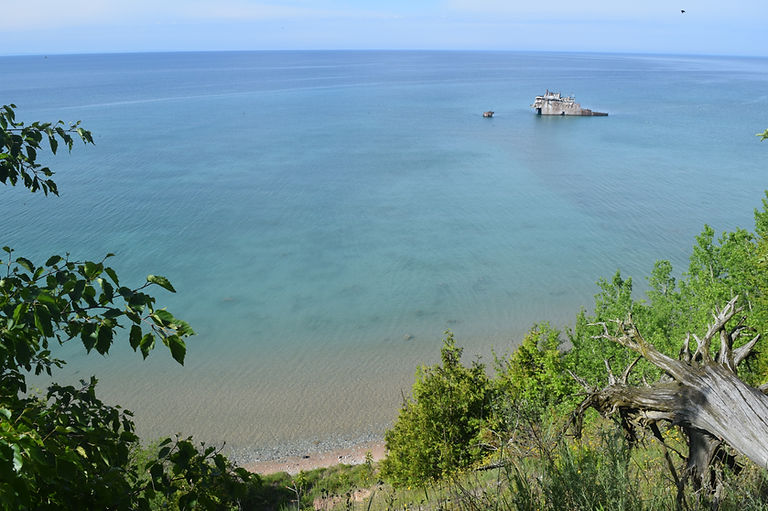
The Francisco Morazan aground off South Manitou Island. Photo: National Park Service (public domain).
Location: Manitou Passage Underwater Preserve
Approximate depth: 10–12 feet
Experience considerations: Shallow wreckage with structural hazards.
Just south of the Francisco Morazan are the remains of the Walter L. Frost, a 235-foot wooden steamer that ran aground on November 4, 1903 — directly beneath the spot where the Morazan came to rest 57 years later.
The vessel's broken hull, boilers, and machinery provide an opportunity to study an older generation of Great Lakes shipping.
Its proximity to the Morazan makes this an interesting destination for divers comparing different types of wrecks.
Why dive here: Shallow maritime history and surviving steamship machinery.
Location: Lake Charlevoix
Approximate depth: Lake bottom around 50 feet; upper structure considerably shallower
Experience considerations: Recreational wreck candidate; verify current conditions and access.
The Keuka has one of the most unusual stories of any Michigan dive site.
Built in 1889 as a timber barge, the vessel later became a floating entertainment venue during Prohibition.
Local legends connect its operation to Al Capone, although the alleged connection has not been conclusively established.
The vessel sank on August 14, 1932, under circumstances that have never been fully explained, and remains a fascinating freshwater wreck.
Its upper structure lies considerably shallower than the lake bottom, creating a striking underwater silhouette.
This is also a location my son Asher and I have personally explored while scuba diving in Lake Charlevoix.
Why dive here: Prohibition history, unusual vessel design, and a memorable local legend.
Location: Little Traverse Bay, Petoskey
Approximate depth: 21 feet
Experience considerations: Confirm current dive access and restrictions; ice diving requires specialized training.
One of Michigan's most extraordinary underwater attractions isn't a shipwreck at all.
About 800 feet offshore from Petoskey lies an 11-foot white marble crucifix depicting Jesus Christ.
The Wyandotte-based Superior Marine Divers Club placed it in Little Traverse Bay on August 12, 1962.
Its history includes a damaged statue imported from Italy and a memorial dedicated to people who lost their lives in the water.
Since 1986, when ice conditions permit, organizers have held winter events where visitors can view the illuminated crucifix through an opening in the ice.
Diving to the site is a separate activity requiring appropriate planning, equipment, permission where applicable, and suitable conditions.
The winter public viewing should never be mistaken for an invitation to attempt ice diving.
Why dive here: A remarkable submerged memorial with a deeply human history.
Location: Near Drummond Island
Approximate depth: 15–25 feet
Experience considerations: Shallow tugboat wreck; confirm currents, conditions, and access.
The General was a 97-foot tugboat lost to a fire on April 7, 1930, off Frying Pan Island.
Located within the DeTour Passage region, it offers a different type of wreck from the large schooners and freighters found elsewhere in Michigan.
The surrounding waters also contain other historic vessels, dock remains, and maritime structures.
Why dive here: A compact historic tugboat in comparatively shallow water.
Location: Thumb Area Underwater Preserve, Lake Huron
Approximate depth: 35 feet
Experience considerations: Recreational wreck candidate; boat access and conditions must be assessed.
The Chickamauga was a 322-foot schooner that foundered in 1919.
It now rests approximately half a mile east of Harbor Beach.
Michigan's underwater-preserve information identifies it as a popular site for divers with less experience compared with the region's deeper wrecks.
Why dive here: A substantial historic schooner at a moderate recreational depth.
Location: Sanilac Shores Underwater Preserve, Lake Huron
Approximate depth: 50 feet
Experience considerations: Recreational wreck candidate with appropriate cold-water and boat-diving experience.
The Sport was a steel-hulled tugboat lost during a December 1920 gale.
Its remains lie mostly upright in approximately 50 feet of water, rising roughly 20 feet above the bottom.
In 1992, the Sport became the first Michigan shipwreck to receive its own Michigan Historical Marker.
Why dive here: A historic steel tugboat with an underwater interpretive marker.
Water depth alone does not determine whether a dive is appropriate.
Cold water, low visibility, currents, boat traffic, entanglement hazards, and overhead structures can make even shallow wrecks demanding.
Work with an experienced local dive operator, stay within your training and personal limits, and avoid wreck penetration without specialized training.
Michigan's lakes can remain cold beneath the surface even during summer.
Exposure protection, equipment familiarity, and an appropriate dive plan are essential.
Divers should be trained and comfortable with their equipment, including dry suits when appropriate.
Respect Michigan's underwater history
Michigan's shipwrecks are protected cultural resources.
Observe without disturbing or removing artifacts.
The underwater-preserve system exists to help keep these sites available to future generations.
Confirm current launch availability, charter operations, weather, visibility, mooring conditions, local restrictions, and emergency arrangements.
A site appearing in a dive guide does not guarantee safe or permitted access on a particular day.
For the wider picture of Michigan's protected bottomlands, start with the Michigan Underwater Preserves system, and use the Explore Michigan hub for shore-side trips to pair with a dive weekend.
Yes. Michigan offers extensive freshwater wreck diving, underwater geological features, and 13 designated underwater preserves.
Some shallow wrecks may be appropriate for divers with suitable certification, training, and conditions. Others require advanced or technical qualifications.
The underwater crucifix is in Little Traverse Bay near Petoskey, approximately 800 feet offshore in about 21 feet of water.
Yes. Some shallow wrecks can be observed by snorkelers, kayakers in clear conditions, or passengers on glass-bottom boat tours. Visibility and safe access vary.
Michigan's underwater world is part adventure, part history lesson, and part natural wonder.
Whether you're exploring a wooden schooner near Munising, discovering the remains of a Prohibition-era barge in Lake Charlevoix, or learning the story behind Petoskey's underwater crucifix, every destination offers a different perspective on the Great Lakes.
The best part is that these places aren't just stories in museums.
For properly trained divers, many can still be explored firsthand.