Introduction: Why a Duplex Might Be Your First Real Estate Investment
When people first think about investing in rental property, they often imagine buying a separate house and finding someone to rent it.
That's certainly one approach.
But there's another type of property that deserves consideration, especially if you're interested in generating rental income while potentially reducing your own housing expenses.
A duplex.
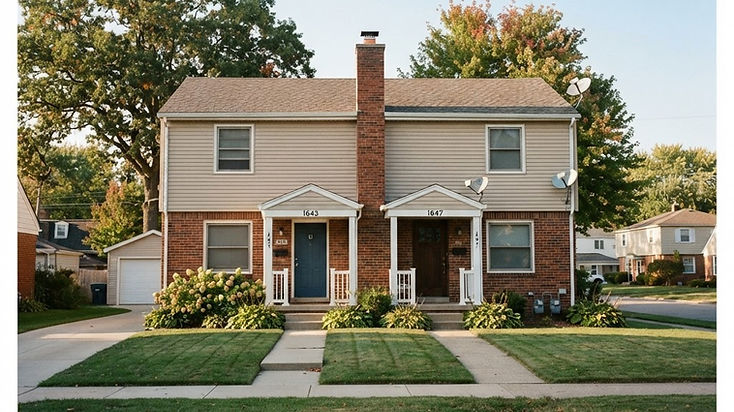
A duplex is a residential property containing two separate living units.
Depending on its design, those units might sit side by side, one above the other, or within another legally approved two-unit configuration.
You might purchase a duplex, live in one unit, and rent the other.
Or you might purchase the entire property as an investment and rent both units.
I've owned a duplex with two rented units, and that experience has given me a practical appreciation for both the opportunities and responsibilities that come with owning a small multifamily property.
A duplex can create two rental-income opportunities within a single property.
But it can also create two sets of maintenance needs, two tenant relationships, and expenses that continue whether the units are occupied or vacant.
The goal isn't simply to find a duplex with attractive rental numbers.
It's to understand what you're buying, what it will cost to own, and whether the property can support itself under realistic conditions.
In this guide, I'll walk through how to approach your first duplex purchase, from choosing a strategy and researching the market to reviewing leases, estimating expenses, and preparing for closing.
A successful first duplex purchase begins with understanding the property as both a physical asset and an ongoing financial responsibility.
1. What Exactly Is a Duplex?
A duplex is generally a residential building or property containing two distinct dwelling units.
Each unit typically has its own living area, kitchen, bathroom, and sleeping accommodations.
Duplexes can have several configurations.
Side-by-Side Duplex
Two units sit next to each other, often with separate entrances.
Each may have its own basement, garage, yard area, or utility connections.
Up-and-Down Duplex
One unit occupies the lower floor, while the other occupies an upper floor.
This layout is common in older residential neighborhoods.
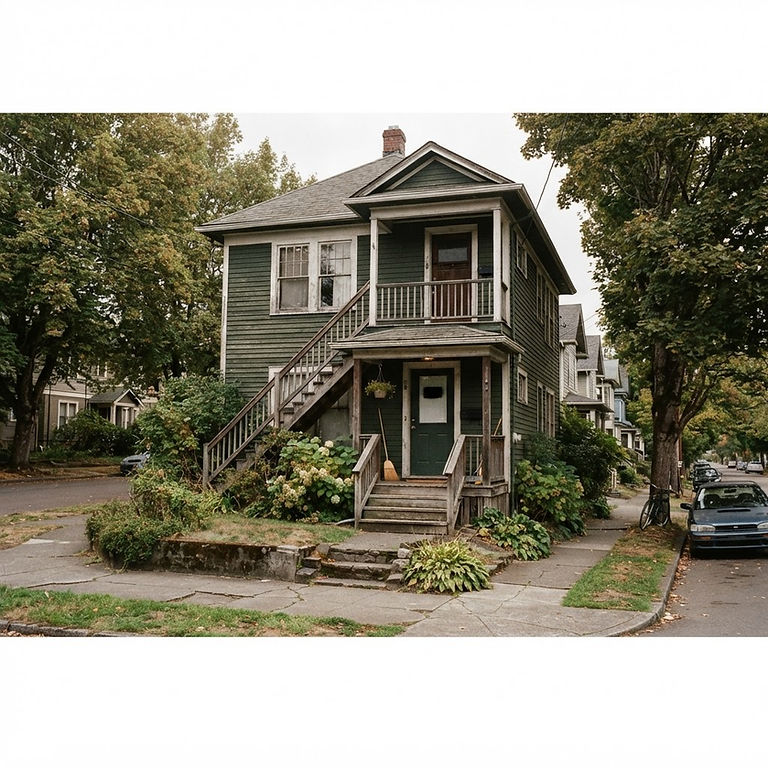
Illustrative photograph of an up-and-down duplex with separate upper and lower units. Generated illustration, not a property owned or offered for rent by the author.
Converted Two-Unit Property
Some properties began as single-family homes and were later converted into two residential units.
A conversion may be legal and properly permitted.
But not every advertised conversion is authorized.
Why Legal Classification Matters
A property that appears to contain two apartments isn't necessarily a legally recognized duplex.
Before purchasing, verify the approved number of residential units through appropriate municipal records and qualified professionals.
A second kitchen, separate entrance, or finished basement does not by itself establish lawful two-unit occupancy.
Never base your investment calculations on rental income from a unit you haven't verified can legally be rented.
2. Two Ways to Buy Your First Duplex
Before looking at properties, decide how you intend to use the building.
That decision affects financing, rental income, personal housing costs, and your responsibilities.
Option A: Live in One Unit and Rent the Other
This is the house-hacking approach we explored in FRP-005.
You occupy one unit as your primary residence and rent the other.
The rent may help offset your housing costs.
Depending on your qualifications and the mortgage program, owner-occupied financing may offer different options from financing a separate investment property.
However, you'll be living next door to your tenant.
You must also comply with your mortgage's occupancy requirements.
Option B: Rent Both Units
You purchase the duplex as a non-owner-occupied investment property.
Both units may generate rental income.
But the property also needs to support its mortgage payments, operating expenses, vacancies, repairs, and capital improvements.
Investment-property financing may require a larger down payment or different underwriting standards than eligible owner-occupied financing.
Comparing the Two Approaches
| Consideration | Live in one unit | Rent both units |
|---|---|---|
| Personal residence | Yes | No |
| Potential rent sources | One unit | Two units |
| Primary goal | Reduce housing costs | Generate investment income |
| Financing | Potential owner-occupied options | Investment-property financing |
| Tenant proximity | Very close | Depends on where you live |
| Vacancy exposure | Loss of one rent stream | Loss of one or both rent streams |
| Owner responsibilities | Both units | Both units |
Neither strategy is automatically better.
The right choice depends on your finances, lifestyle, financing eligibility, and long-term goals.
3. Why Investors Consider Duplexes
A duplex can offer several advantages over owning a single rental home.
Two Potential Rental-Income Sources
If both units are legally rentable, you may collect rent from two separate households.
For example:
| Unit | Monthly rent |
|---|---|
| Unit A | $1,200 |
| Unit B | $1,100 |
| Total gross monthly rent | $2,300 |
| Annual gross scheduled rent | $27,600 |
This is gross scheduled rental income before vacancies, concessions, nonpayment, and expenses.
Partial Occupancy Can Still Generate Income
If one unit becomes vacant, the other may remain occupied.
That's different from a single-family rental, where one vacancy generally eliminates all rental income.
But one occupied unit may still be insufficient to cover the property's expenses.
One Property to Maintain
You may have one roof, one parcel, and some shared infrastructure.
That can create operational efficiencies.
However, it can also mean that a major building-level repair affects both units.
Potential Long-Term Flexibility
Depending on legal use, financing, and personal circumstances, a duplex may support different arrangements over time.
You might live in one unit initially.
Later, you may be able to rent both units after satisfying applicable obligations.
But don't assume every future conversion is automatically permitted.
The value of a duplex comes from its actual economics and condition, not simply the fact that it has two units.
4. How Much Does It Cost to Buy a Duplex?
The amount of money required depends on the purchase price, financing program, property condition, closing costs, and reserves.
Let's examine a hypothetical purchase.
Example: $250,000 Duplex
| Purchase expense | Illustrative amount |
|---|---|
| Purchase price | $250,000 |
| Down payment at 20% | $50,000 |
| Closing costs at 3% | $7,500 |
| Initial repairs and setup | $5,000 |
| Initial cash reserve | $10,000 |
| Estimated initial cash requirement | $72,500 |
The 20% down payment is an example, not a universal requirement.
An eligible owner-occupied purchase may have different financing options.
An investment-property purchase may require different down-payment, reserve, and underwriting terms.
Closing costs also vary.
Why Cash Reserves Matter
You may need to address repairs immediately after purchasing.
A tenant could move out.
An appliance might fail.
A major system could require service.
A lender may also impose reserve requirements.
Your investment should not depend on having no unexpected expenses after closing.
The Difference Between Purchase Price and Total Cost
A $250,000 property doesn't necessarily mean you need only $50,000 in cash.
Your actual acquisition budget must include the full transaction and the funds needed to operate the property responsibly.
Before shopping for duplexes, establish a realistic total cash budget—not just a target purchase price.
5. Understanding Duplex Financing
Financing a duplex is not necessarily the same as financing a single-family home.
Your intended occupancy matters.
Owner-Occupied Financing
If you genuinely intend to live in one unit as your primary residence, certain mortgage programs may allow you to finance an eligible two-unit property under owner-occupied rules.
Potential options may include conventional, FHA-insured, or VA-backed financing, subject to program and borrower eligibility.
Requirements vary by lender, property type, and loan program.
Investment-Property Financing
If you intend to rent both units without occupying either, the lender generally evaluates the purchase as an investment property.
Down-payment requirements, rates, reserves, and underwriting may differ.
Can Rental Income Help You Qualify?
Some mortgage programs allow qualifying rental income to be considered.
But the lender may apply adjustments or require leases, appraisals, or other documentation.
Do not assume the lender will count the full advertised rent.
Questions to Ask Your Lender
Before making an offer, ask:
- What financing options are available for this specific two-unit property?
- What down payment and closing costs should I expect?
- How will projected or existing rental income be treated?
- What reserves are required?
- Are there property-condition or appraisal restrictions?
- What occupancy obligations apply?
- How would mortgage insurance affect my payment?
- What documentation is needed for existing tenants and leases?
Never Misrepresent Occupancy
If you plan to rent both units immediately, do not apply for owner-occupied financing by claiming you intend to live there.
Mortgage occupancy representations are serious legal and contractual obligations.
Choose financing that accurately reflects how you intend to use the property.
6. Where Should You Look for Your First Duplex?
Location matters for both the value of the property and its rental demand.
A low purchase price doesn't automatically make a duplex a good investment.
Look for Consistent Rental Demand
Consider areas near employment, schools, transportation, healthcare, and other amenities.
Research whether similar units are attracting tenants.
Compare Local Rents
A duplex with two units renting for $1,000 each may have very different economics from one with units renting for $1,400 each.
But higher rent doesn't always mean better cash flow if purchase prices and expenses are also higher.
Understand the Neighborhood
Look at:
- General property conditions.
- Housing inventory.
- Rental demand.
- Local vacancy patterns.
- Access to employment.
- Transportation.
- Parking.
- Relevant local regulations.
Consider Property Management
If the duplex is far from where you live, repairs and tenant issues may be more difficult to coordinate.
You may need professional management.
That cost belongs in your analysis.
Don't Rely on One Listing
Compare multiple properties.
Review both sale prices and rental rates.
Learn what typical duplexes in the area actually cost to operate.
The right market is one where the property, rental demand, and purchase price work together—not simply the place with the cheapest listing.
7. How to Find Duplexes for Sale
You can search for duplexes through several channels.
Real Estate Listing Platforms
Major real estate websites may allow filtering by multifamily or two-unit properties.
Verify how the listing classifies the property.
Local Real Estate Agents
An agent experienced with small multifamily transactions may help identify properties and explain local market conditions.
Multiple Listing Service Data
A qualified agent may be able to provide comparable sales and listing history.
Local Investors and Property Owners
Some properties may be offered through investor networks or direct owner marketing.
However, off-market opportunities still require careful verification.
Foreclosures and Distressed Properties
These can sometimes offer opportunities.
They can also carry significant repair, financing, title, occupancy, or legal risks.
Questions to Ask About Every Listing
- Is it legally a two-unit property?
- Are both units occupied?
- What are the current rents?
- Are there written leases?
- Are utilities separately metered?
- What major repairs have been completed?
- What work is still needed?
- Are there known code violations?
- What expenses does the owner pay?
- Why is the property being sold?
A promising listing is an invitation to investigate—not evidence that the property is a good investment.
8. How to Estimate Rental Income
Rental income is one of the most important inputs in a duplex analysis.
But you need to distinguish between what a seller claims and what the property can reasonably produce.
Scheduled Rent
This is the rent that would be due if both units were occupied under the assumed lease terms.
Actual Collected Rent
This is the amount tenants actually pay.
The two figures may differ because of vacancy, concessions, delinquency, or other issues.
Market Rent
This is an estimate of what a comparable unit might reasonably rent for under current market conditions.
Market rent isn't guaranteed.
Example
| Rent measure | Unit A | Unit B | Total |
|---|---|---|---|
| Current contractual monthly rent | $1,100 | $1,000 | $2,100 |
| Illustrative estimated market rent | $1,200 | $1,150 | $2,350 |
A seller might advertise the property based on the higher market-rent estimate.
But if the units are currently leased at lower amounts, you generally cannot assume immediate increases.
Lease terms and applicable law may restrict when and how rent can change.
Research Comparable Units
Compare properties with similar bedrooms, bathrooms, condition, utilities, parking, and location.
Be conservative.
Analyze the income you can reasonably expect—not the highest rent someone suggests might be possible.
9. Understanding Duplex Operating Expenses
Gross rental income is only the starting point.
Owning a duplex involves expenses that reduce the amount available to pay debt service or generate cash flow.
Property Taxes
Taxes may change following a sale or reassessment.
Research the rules that apply to the property.
Insurance
A duplex used as a rental may require different coverage than a typical owner-occupied single-family home.
Obtain an appropriate quote.
Maintenance
Plumbing, electrical systems, appliances, flooring, and other components require upkeep.
Capital Improvements
Major replacements can include roofs, furnaces, water heaters, windows, and structural repairs.
These costs may be irregular but substantial.
Vacancy and Collection Loss
A unit may sit empty.
A tenant may pay late or fail to pay.
Use a reasonable allowance in your financial planning.
Utilities
Some duplexes have separate utility meters.
Others share services.
Verify who is responsible for each expense.
Property Management
Even if you manage the property yourself, consider what professional management would cost.
Other Expenses
Potential costs include:
- Lawn care.
- Snow removal.
- Pest control.
- Common-area maintenance.
- Permits and inspections.
- Accounting and legal services.
- Leasing and turnover costs.
A duplex that looks profitable before expenses may produce very little cash flow after them.
10. How to Calculate Duplex Cash Flow
Let's evaluate a hypothetical duplex purchased as a fully rented investment property.
Assume:
- Both units are rented.
- Unit A generates $1,300 per month.
- Unit B generates $1,200 per month.
- Monthly mortgage principal and interest total $1,350.
Example Monthly Analysis
| Item | Monthly amount |
|---|---|
| Unit A rent | $1,300 |
| Unit B rent | $1,200 |
| Gross scheduled rent | $2,500 |
| Vacancy and collection allowance | -$125 |
| Property taxes | -$350 |
| Property insurance | -$150 |
| Maintenance | -$175 |
| Property management | -$200 |
| Owner-paid utilities | -$100 |
| Other operating expenses | -$50 |
| Simplified net operating income | $1,350 |
| Mortgage principal and interest | -$1,350 |
| Capital improvement reserve | -$150 |
| Estimated monthly cash flow | -$150 |

Illustrative photograph of a prospective duplex buyer reviewing purchase costs and rental expenses. Generated illustration.
Under these assumptions, the property produces a negative estimated cash flow of $150 per month.
That doesn't necessarily mean the property has no investment value.
But it means the owner may need to contribute additional money to cover the modeled monthly cash requirements.
Net Operating Income Versus Cash Flow
Net operating income, or NOI, generally reflects property income after operating expenses but before financing costs and income taxes.
Mortgage principal and interest are not included in NOI.
Capital expenditures are generally treated separately from recurring operating expenses in standard NOI analysis.
For this educational example, the capital improvement reserve is deducted after NOI to estimate available cash flow.
Why the Distinction Matters
A property can have positive NOI but negative cash flow after debt service and reserves.
That's why you need to examine more than one financial measure.
Never buy a duplex based solely on gross rent or a seller's claim that the property pays for itself.
11. What Happens When One Unit Is Vacant?
A duplex has two potential rental-income streams.
But a vacancy can still create significant financial pressure.
Using the example above:
| Occupancy scenario | Gross scheduled or collected rent |
|---|---|
| Both units occupied | $2,500 |
| Only Unit A occupied | $1,300 |
| Only Unit B occupied | $1,200 |
| Both units vacant | $0 |
Your mortgage payment, taxes, insurance, and many other costs continue even when rent stops.
Stress-Test the Property
Ask:
- Can I cover the payment if one unit is vacant?
- What if both units are vacant?
- What if a major repair occurs during a vacancy?
- How long could I operate the property without rental income?
- How much cash should I reserve?
A vacancy allowance helps model expected long-term losses.
But a real vacancy can cause a much larger short-term cash shortfall than the monthly allowance suggests.
Your first duplex should be able to survive realistic setbacks without creating an immediate personal financial crisis.
12. Inspecting a Duplex Before You Buy
A duplex inspection deserves particular attention because you're evaluating two separate living spaces and potentially shared building systems.
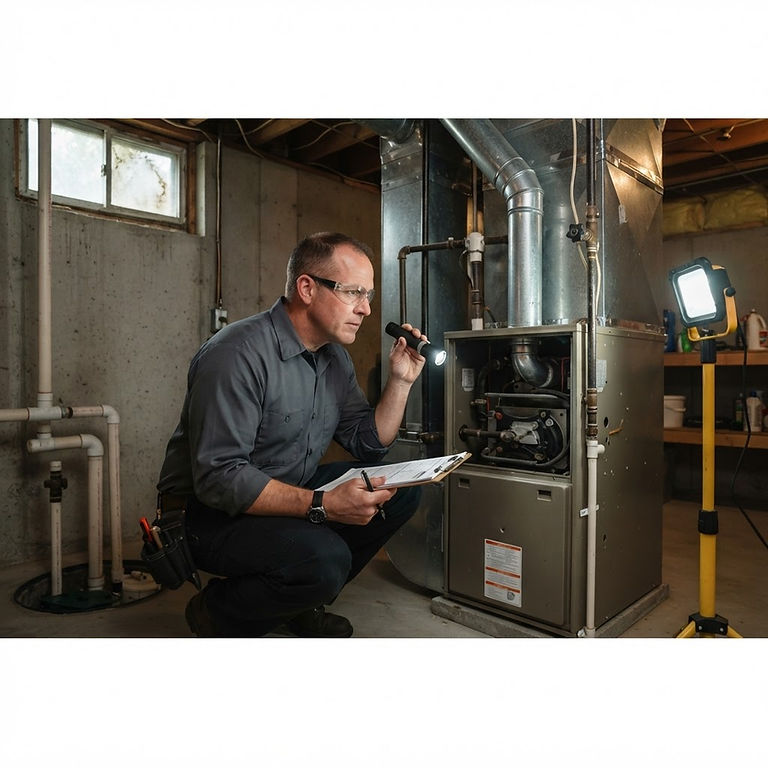
Illustrative photograph of a home inspector examining a building system. Generated illustration.
Inspect Both Units
Do not assume that one well-maintained unit means the other is in similar condition.
Review kitchens, bathrooms, floors, walls, ceilings, windows, and appliances in each unit.
Roof and Exterior
Look for visible deterioration, drainage problems, damaged siding, and other potential issues.
Foundation and Structure
Structural problems can be expensive.
Have concerning conditions evaluated by qualified professionals.
Plumbing
Determine whether systems are shared or separate.
Inspect for leaks, drainage issues, and aging equipment.
Electrical
Verify the condition and capacity of electrical systems.
Determine whether each unit has separate service or metering.
Heating and Cooling
Some duplexes have separate furnaces.
Others share heating systems.
Understand who controls and pays for the service.
Fire and Life Safety
Verify applicable requirements for smoke alarms, carbon monoxide alarms, exits, fire separation, and other safety features.
Rental Compliance
Check whether required inspections, registrations, or rental certificates are current.
Obtain Repair Estimates
If an inspection identifies major problems, get qualified estimates before deciding whether to proceed.
A professional inspection is not an expense to skip simply because the rental numbers look attractive.
13. Buying a Duplex With Existing Tenants
Many duplexes are sold while one or both units are occupied.
That can provide immediate rental income.
But it also introduces important due-diligence requirements.
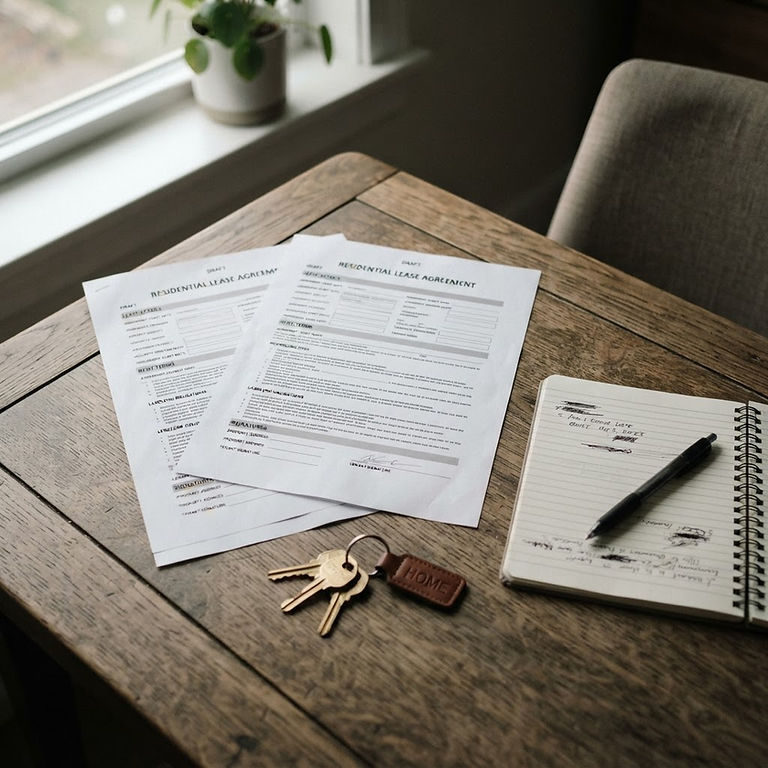
Illustrative photograph of lease documents and keys being reviewed before a purchase. Generated illustration.
Request the Existing Leases
Review:
- Rent amounts.
- Lease start and end dates.
- Security deposits.
- Utility responsibilities.
- Pet provisions.
- Maintenance obligations.
- Any written amendments.
Verify Payment Information
Where lawfully available, request appropriate rent records and reconcile them with the seller's representations.
Do not assume scheduled rent equals collected rent.
Understand Security Deposits
Security deposits may need to be transferred or accounted for at closing under applicable law.
The buyer and seller should address these obligations in the transaction documents.
Review Tenant Communications and Disputes
Ask about documented maintenance requests, outstanding disputes, and known compliance issues.
Understand That Leases May Continue
Buying a property does not necessarily terminate existing tenant rights or lease obligations.
The new owner may inherit contractual and statutory responsibilities.
Don't Assume You Can Immediately Raise Rent
Rent changes may be restricted by existing lease terms and applicable law.
Occupancy Plans Need Special Attention
If you're purchasing with owner-occupied financing but both units are rented, discuss possession, lease timing, and occupancy requirements with your lender and qualified professionals before committing to the purchase.
Existing tenants can be an asset, but their leases and rights must be treated as part of the property you're buying.
14. Understanding Utilities and Shared Expenses
Utilities can significantly affect duplex cash flow.
Before buying, determine exactly how each service is billed.
Separately Metered Utilities
Each unit may have its own gas, electric, or water service.
That can simplify certain billing arrangements.
But separate meters do not automatically determine legal responsibility for payment.
Shared Utilities
Some duplexes share water, heating, or other systems.
The owner may be responsible for those bills.
Common Areas
You may also pay for exterior lighting, shared laundry, hallways, or other common-area services.
Example
Imagine a duplex generating $2,500 in monthly rent.
If the owner pays an additional $200 per month in utilities that were not included in the original analysis, estimated cash flow decreases by $200.
That can change a marginal investment into a negative one.
Verify Before Closing
Request utility history where available.
Review leases and billing arrangements.
Understand applicable utility billing laws.
Never assume tenants pay every utility simply because the property has two units.
15. Common Mistakes First-Time Duplex Buyers Make
There are several mistakes I would encourage beginners to avoid.
Mistake 1: Believing the Listing's Income Projections
Projected rent is not the same as documented rent.
Mistake 2: Ignoring Property Condition
A low purchase price can be offset by expensive repairs.
Mistake 3: Underestimating Operating Expenses
Taxes, insurance, maintenance, and vacancies can consume a large share of rent.
Mistake 4: Assuming Both Units Are Legal
Verify permitted use and occupancy.
Mistake 5: Overlooking Existing Leases
Lease obligations may continue after the sale.
Mistake 6: Spending Every Dollar on the Purchase
Without reserves, a repair or vacancy can create immediate financial pressure.
Mistake 7: Using Optimistic Rent Increases
Don't assume you can immediately increase rent to the highest advertised market rate.
Mistake 8: Forgetting Your Own Time
Tenant communication, maintenance coordination, bookkeeping, and compliance take effort.
Mistake 9: Ignoring Vacancy Scenarios
A property that only works with both units occupied at all times is vulnerable.
Mistake 10: Buying Because You Feel Rushed
There will be other properties.
Don't let urgency replace due diligence.
A disciplined decision to walk away can be just as valuable as finding the right property.
16. From the Field: What Owning a Duplex Has Taught Me
Owning a duplex has helped me understand how small residential rental properties operate beyond the numbers on a listing.
A duplex may look simple because it contains only two units.
But each unit represents a separate living arrangement, with its own occupants, maintenance needs, and expectations.
Even when both units are rented, the owner's responsibilities don't disappear.
The property still needs attention.
Repairs still happen.
Expenses still need to be tracked.
Tenants still need communication.
And the building still needs long-term maintenance planning.
One of the things I appreciate about a duplex is that it gives you the opportunity to manage more than one rental-income source within a single property.
But that benefit comes with the responsibility of maintaining the entire building.
I also think it's important to look beyond the current month's rent.
A property may collect rent consistently for several months and then require an expensive repair.
That doesn't necessarily make it a bad investment.
It means you need to plan for the full ownership experience.
If I were evaluating my first duplex again, I would want a clear understanding of the property condition, existing leases, rental demand, ongoing expenses, and how much money I'd need available after closing.
The lesson I would pass along is simple: buy the property based on what you can verify and afford—not what you hope the numbers will become.
17. Try It Yourself: Evaluate a Duplex Before Making an Offer
Before making an offer, work through a basic investment worksheet.
Property Information
| Question | Your answer |
|---|---|
| Property address | |
| Asking price | |
| Legal number of units | |
| Unit A bedrooms and bathrooms | |
| Unit B bedrooms and bathrooms | |
| Current occupancy | |
| Intended use | |
| Known repair needs |
Purchase Budget
| Item | Estimate |
|---|---|
| Purchase price | $ |
| Down payment | $ |
| Closing costs | $ |
| Initial repairs | $ |
| Cash reserves | $ |
| Total initial cash requirement | $ |
Monthly Rental Income
| Item | Estimate |
|---|---|
| Unit A rent | $ |
| Unit B rent | $ |
| Gross scheduled rent | $ |
| Vacancy and collection allowance | -$ |
| Effective rental income | $ |
Monthly Operating Expenses
| Item | Estimate |
|---|---|
| Property taxes | $ |
| Insurance | $ |
| Maintenance | $ |
| Property management | $ |
| Owner-paid utilities | $ |
| Other operating expenses | $ |
| Total operating expenses | $ |
Monthly Cash Flow
| Item | Estimate |
|---|---|
| Effective rental income | $ |
| Operating expenses | -$ |
| Net operating income | $ |
| Mortgage principal and interest | -$ |
| Capital improvement reserve | -$ |
| Estimated monthly cash flow | $ |
Run Three Scenarios
Scenario A: Both Units Occupied
Calculate the expected monthly cash flow using realistic rental assumptions.
Scenario B: One Unit Vacant
Remove one unit's rent and calculate the shortfall or remaining cash flow.
Scenario C: Major Repair
Estimate the effect of a significant repair expense occurring during a vacancy.
Questions Before You Make an Offer
Can you afford the property under conservative assumptions?
Are both units legally recognized?
Have you reviewed the leases?
Have you verified the property's condition?
Do you have sufficient reserves?
Do you understand your financing obligations?
If you can't answer those questions, you may need more information before making a purchase decision.
18. Your First Duplex Buying Checklist
Use this checklist as a practical starting point.
Financial Preparation
:::checklist
- [ ] Review personal finances and debts.
- [ ] Determine a realistic purchase budget.
- [ ] Speak with a qualified lender.
- [ ] Understand down-payment and reserve requirements.
- [ ] Establish an emergency reserve.
Property Research
- [ ] Research local duplex sale prices.
- [ ] Compare rental rates.
- [ ] Verify legal unit count.
- [ ] Research rental licensing requirements.
- [ ] Review property taxes and insurance estimates.
Due Diligence
- [ ] Inspect both units.
- [ ] Review major building systems.
- [ ] Obtain repair estimates.
- [ ] Review existing leases.
- [ ] Verify available rent records.
- [ ] Review security deposit obligations.
- [ ] Confirm utility responsibilities.
- [ ] Evaluate title and transaction documents with qualified professionals.
Investment Analysis
- [ ] Calculate gross scheduled rent.
- [ ] Include vacancy and collection loss.
- [ ] Estimate operating expenses.
- [ ] Calculate NOI.
- [ ] Include debt service and capital reserves.
- [ ] Stress-test one-unit and two-unit vacancy.
- [ ] Evaluate available cash after closing.
Closing Preparation
- [ ] Confirm financing and appraisal requirements.
- [ ] Review inspection findings and contingencies.
- [ ] Verify insurance arrangements.
- [ ] Confirm lease and deposit transfer procedures.
- [ ] Arrange utilities and property management.
- [ ] Prepare a post-closing maintenance plan.
This checklist is educational and does not replace transaction-specific professional advice.
19. What to Do After You Buy Your First Duplex
Closing day is an important milestone.
But it's also the beginning of operating the property.
Organize Your Documents
Keep copies of:
- Closing documents.
- Insurance policies.
- Mortgage information.
- Leases.
- Security deposit records.
- Inspection reports.
- Repair warranties.
- Utility information.
- Required permits or licenses.
Establish a Financial Tracking System
Track rental income, expenses, repairs, and reserves.
Keep personal and rental financial activity appropriately organized.
Introduce Yourself to Existing Tenants
Provide appropriate contact information and explain how maintenance requests should be submitted.
Respect existing lease obligations.
Review Property Maintenance
Create a schedule for routine inspections and preventative maintenance, consistent with applicable laws and lease terms.
Prepare for Unexpected Expenses
Don't treat every dollar of rent collected as available personal income.
Some of it may need to remain available for future property obligations.
Your first goal after closing should be to operate the property reliably—not immediately maximize the money you withdraw from it.
Key Takeaways
A duplex can be an accessible entry point into small multifamily rental ownership, depending on your finances and market.
You can potentially live in one unit and rent the other, or purchase the property as a fully rented investment.
Financing requirements depend on occupancy, loan program, property type, and borrower qualifications.
Verify the legal unit count before relying on rental income.
Research actual rents, existing leases, operating expenses, and property condition.
Distinguish gross rental income, NOI, and cash flow.
Plan for vacancies, repairs, and major replacements.
Protect yourself with appropriate due diligence and financial reserves.
And remember that buying a duplex means taking responsibility for an entire property and the people who live there.
The best first duplex isn't necessarily the one with the highest projected rent. It's the one you understand, can responsibly afford, and can manage through both good months and difficult ones.
What's Next: Buying a Second Home as a Rental Property
A duplex is one path into residential rental ownership.
Another approach is purchasing a separate home specifically to rent to someone else.
In the next lesson, we'll explore how buying a second property differs from purchasing your primary residence, including financing, down payments, cash reserves, rental-income analysis, and the responsibilities of managing a property you don't live in.
Next in the series: FRP-007 — Buying a Second Home as a Rental Property
This article is provided for general educational purposes and does not constitute individualized financial, mortgage, investment, legal, tax, or insurance advice. Loan programs, property eligibility, occupancy rules, zoning, landlord-tenant requirements, licensing, insurance, and tax treatment vary by jurisdiction and circumstance. All financial examples are hypothetical and do not represent the author's actual property finances or guarantee rental income, cash flow, appreciation, or investment performance. Verify current requirements with qualified professionals and relevant authorities before purchasing or operating rental property.
© Brad Merritt. All rights reserved.