- Best for: Spring woodland wildflowers and wetlands
- Difficulty: Easy to moderate
- Recommended walk: Woodland Trail, 3.25 miles, with shorter options
If I were recommending one place to start looking for spring woodland wildflowers in Oakland County, Indian Springs Metropark would be near the top of the list.
The park protects an impressive landscape of woods, wetlands, and the Great Huron Swamp.
Its Woodland Trail passes through mature trees, vernal pools, and wetland habitats. In spring, these environments provide excellent opportunities to look for ephemeral wildflowers—plants that emerge, flower, and complete much of their growing cycle before the forest canopy fills with leaves.
The Metroparks specifically identify the Woodland Trail as a place to experience spring ephemeral wildflowers.
Look carefully along the trail edges for delicate flowers and the first signs of life in the wetland forest.
The boardwalks are also excellent places to appreciate the swamp without disturbing its fragile soils.
Best spring experience: Walk the Woodland Trail during April or May, adjusting your route to current conditions.
Know before you go: Nature trails prohibit pets, bicycles, and running. Spring mud is common, and flowers should be enjoyed without leaving the trail.
- Best for: Spring beauties, flowering dogwoods, and river woodland
- Difficulty: Easy
- Recommended walk: Acorn Nature Trail, 2 miles
Hudson Mills Metropark is a wonderful choice for anyone who enjoys peaceful woodland walks near the Huron River.
The Acorn Nature Trail winds through wooded areas, vernal pools, and habitats shaped by the river.
The Metroparks specifically describe spring beauty wildflowers carpeting portions of the forest floor during the season. Flowering dogwoods add another reason to visit as spring progresses.
The trail also offers opportunities to observe birds, wetland plants, and the changing forest.
At approximately two miles with relatively little elevation change, it's a manageable outing for many casual walkers.
Best spring experience: Take your time along the Acorn Nature Trail, especially where the woods meet wetter ground.
Know before you go: Pets, bicycles, and running are prohibited on the nature trail. Check for muddy conditions after spring rain.
- Best for: Trilliums and accessible urban nature
- Difficulty: Easy
- Recommended area: Britton Woods Nature Area
County Farm Park is one of those places that proves you don't have to leave a city behind to discover beautiful natural spaces.
Within the park, Britton Woods Nature Area preserves an approximately 18-acre woodland with a mixture of upland and floodplain tree species.
Washtenaw County specifically identifies trilliums and other woodland wildflowers in Britton Woods.
That makes it a particularly appealing destination for spring flower photography and slow, observant walks.
The surrounding park also includes gardens, open spaces, and walking paths, offering a pleasant combination of cultivated landscapes and natural woodland.
Best spring experience: Explore Britton Woods, then enjoy the park's gardens and other walking areas.
Know before you go: Picking wildflowers is prohibited. Bicycles are not allowed in Britton Woods. Follow posted trail rules.
- Best for: Native woodland plants, spring gardens, and nature education
- Difficulty: Easy to moderate
- Recommended walk: Sam Graham Trees Trail and Woodland Wildflower Garden
Matthaei Botanical Gardens offers a different kind of spring adventure.
Instead of simply walking through a forest and hoping to discover something blooming, visitors can explore a landscape designed to highlight Michigan's natural communities.
The Sam Graham Trees Trail moves through wetlands, floodplain forest, and a tamarack swamp before reaching drier upland habitats.
One particularly interesting feature is the Helen V. Smith Woodland Wildflower Garden, which connects the lower wetlands with higher woodland environments.
It's an excellent place to slow down and learn about native plants while exploring a variety of habitats.
The gardens also offer seasonal plant displays, making Matthaei a rewarding destination even when the earliest woodland wildflowers have finished blooming.
Best spring experience: Explore the Woodland Wildflower Garden and Sam Graham Trees Trail, then visit the seasonal display gardens.
Know before you go: Garden and conservatory hours may differ from outdoor trail access. Check visitor information and parking details before arriving.
- Best for: Spring flowers, wooded hills, and Huron River views
- Difficulty: Easy to moderate, with hills
- Recommended walk: Arboretum trails through the main valley and Heathdale
Nichols Arboretum is one of the most beautiful places in Southeast Michigan to experience the changing seasons.
Located along the Huron River in Ann Arbor, the Arb combines wooded trails, natural areas, flowering plant collections, and scenic valleys.
Nearly 3.5 miles of trails connect its entrances and different landscape areas.
For spring flowers, Heathdale is particularly interesting. This woodland collection features azaleas and rhododendrons that bloom in stages from May into June, along with native ferns and woodland wildflowers.
The famous W.E. Upjohn Peony Garden provides another spectacular late-spring attraction.
The Arb isn't exclusively a native wildflower preserve; part of its appeal comes from the combination of natural woodland and cultivated flowering collections.
Best spring experience: Walk the wooded trails in April or May, then return later for the peony display.
Know before you go: Some trails are steep. The Arb allows walking and hiking, but not bicycles. Dogs must be leashed.
- Best for: Woodland wildflowers and easy nature trails
- Difficulty: Easy
- Recommended walk: Big Tree Trail, 0.75 mile
Oakwoods Metropark offers one of the most approachable woodland walking experiences in the southern part of Metro Detroit.
Its nature trails pass through mature woods, wetland areas, and habitats along the Huron River.
The Big Tree Trail is a particularly good choice for a spring outing. It features hardwood forest, interesting natural features, and a vernal pond.
The Metroparks have also documented a wide variety of wildflowers at Oakwoods, including spring beauty, bloodroot, trout lily, trillium, and jack-in-the-pulpit.
Not every species blooms at the same time, so repeated visits can reveal different parts of the season.
Best spring experience: Walk Big Tree Trail and visit the Nature Center to learn more about the local habitat.
Know before you go: Dogs, bicycles, and running are not permitted on nature trails. The park also has other trail types with different rules.
- Best for: Diverse forest habitats and a more adventurous spring hike
- Difficulty: Moderate to challenging, depending on route
- Recommended area: Haven Hill Natural Area and designated hiking trails
Highland Recreation Area is one of the most interesting natural landscapes in Oakland County.
Its rolling hills, lakes, forests, and glacial terrain create a wide variety of environments within one park.
The Michigan DNR identifies the recreation area as home to southern Michigan's principal forest types and a rich variety of wildflowers and other plants.
The Haven Hill Natural Area is particularly notable for its range of habitats, from swamp forests to hardwood stands.
For someone who enjoys both hiking and nature observation, Highland offers the opportunity to combine a more substantial walk with spring woodland scenery.
Best spring experience: Choose an established hiking route through woodland habitat and allow extra time for nature observation.
Know before you go: Some trails are rugged or shared with other activities. Check the official map, stay out of sensitive habitats, and expect muddy sections in spring.
- Best for: Spring woodland walks, wetlands, and wildlife
- Difficulty: Easy to moderate
- Recommended walk: Deer Run or Wildwing Nature Trail
Kensington Metropark is one of my favorite kinds of destinations to recommend because it offers so many ways to enjoy the outdoors in one place.
The park's Nature Center trail network passes through mixed forest, marshland, and lakeside habitat.
Deer Run is a relatively approachable woodland route, while Wildwing offers boardwalks, marsh views, and excellent opportunities to observe wildlife.
Kensington has a documented history of spring woodland wildflowers, although plant abundance changes over time and should never be taken for granted.
The park is also a rewarding place for spring birdwatching, especially around the wetlands and heron rookery.
Best spring experience: Walk Deer Run for woodland scenery or Wildwing for a combination of wetlands, birds, and early-season plant life.
Know before you go: Pets, bicycles, and running are prohibited on Nature Center trails. Stay on designated routes and do not enter sensitive woodland areas to photograph flowers.
- Best for: Peaceful forest walking and spring greenery
- Difficulty: Easy to moderate
- Recommended area: Designated hiking trails
Maybury State Park is a convenient escape from the busy suburbs around Northville.
The park features rolling hills, meadows, woodlands, and a network of recreational trails.
Spring is a particularly appealing time to visit as the forest begins to turn green and the meadows come back to life.
Unlike some of the earlier destinations, Maybury is included primarily for its pleasant spring walking environment rather than a verified concentration of particular wildflower species.
That makes it a good option for visitors who want a relaxing outdoor walk and are happy to appreciate whatever seasonal plants and wildlife they encounter.
Best spring experience: Choose a designated hiking trail and enjoy the transition between wooded areas and open meadows.
Know before you go: Hiking, mountain biking, and horseback riding have designated routes. Check current maps and trail notices before visiting.
- Best for: Huron River woodland scenery and spring wildlife
- Difficulty: Easy to moderate, depending on route
- Recommended area: Established hiking trails near the Huron River
Proud Lake Recreation Area is another excellent place to experience spring near Milford and Commerce Township.
The park protects approximately 3,000 acres of forests, wetlands, and river habitat.
The Huron River is central to the landscape, creating an environment where spring bird activity, emerging plants, and changing water levels become part of the experience.
One important feature deserves special attention: Proud Lake contains a legally dedicated Nature Study Area with a rare and fragile bog ecosystem.
The DNR describes this area as difficult to access and botanically significant.
That is a reason to protect it—not an invitation to leave established trails or attempt to enter the bog.
Best spring experience: Enjoy the designated public hiking trails and river scenery while observing woodland plants from the trail.
Know before you go: Do not attempt to access the fragile bog or other restricted natural areas. Use the official trail map and follow posted rules.
- Best for: Woodland walks, lake scenery, and nature education
- Difficulty: Easy to moderate
- Recommended area: Established trails near Wint Nature Center
Independence Oaks is Oakland County's largest county park, with a landscape of woodlands, wetlands, and lake habitat.
Its extensive trail network makes it a rewarding place to explore throughout the year.
In spring, the woods become especially interesting as native plants emerge and birds return to more active routines.
The park's natural resource programs also emphasize the protection and restoration of native spring flowers, including efforts to manage invasive plants that compete with woodland vegetation.
Wint Nature Center adds an educational dimension to the visit.
Best spring experience: Choose a woodland trail near the Nature Center and enjoy a slower walk focused on the seasonal changes around you.
Know before you go: This is a general spring nature destination rather than a guaranteed wildflower display. Follow designated trails and current park rules.
- Best for: Spring forest habitats and a longer nature outing
- Difficulty: Easy to moderate
- Recommended area: Nature Center trails and designated woodland routes
Stony Creek Metropark rounds out this list with a combination of mature forest, wetlands, and beautiful natural scenery.
The park's woodland habitats provide an opportunity to see Southeast Michigan's forest ecosystem during one of its most active seasons.
The Metroparks identify the Nature Center area as a place to explore southern Michigan's maple-beech forest habitat.
It's a great destination for visitors who enjoy walking beneath mature trees, looking for new plant growth, and listening for spring birds.
Rather than expecting a specific wildflower display, approach this as a broader spring nature walk.
Best spring experience: Explore the Nature Center area and connect your visit with other designated walking trails.
Know before you go: Check the park's current maps for trail uses, restrictions, and conditions.
The timing varies from year to year, but the season generally develops in stages.
| Period | What to look for |
|---|
| Late March–early April | Skunk cabbage and the earliest signs of wetland growth |
| Mid-April | Bloodroot, spring beauty, and other early woodland flowers, depending on weather |
| Late April–early May | Trout lilies, trilliums, and a wider variety of spring ephemerals |
| Mid–late May | Later woodland flowers, fresh green foliage, and flowering trees |
| Late May–June | Peonies, azaleas, rhododendrons, and other late-spring displays |
These are approximate windows, not bloom forecasts.
A cold spring can delay flowers, while an unusually warm period can move the season forward quickly.
The Michigan DNR's spring wildflower guide is a useful companion for identifying common species.
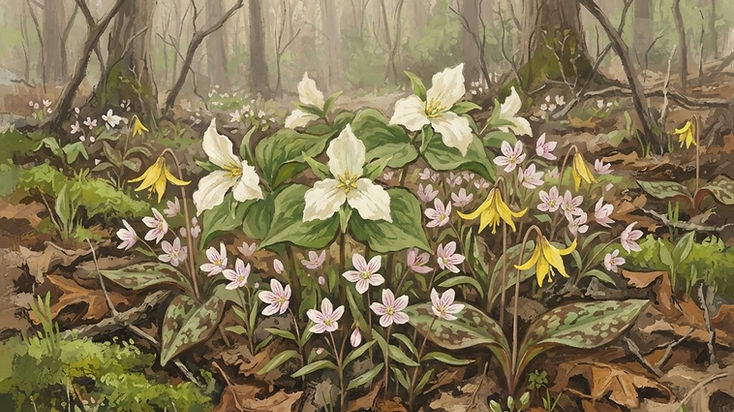
- Spring beauty: Small, pale flowers often marked with delicate pink veins.
- White trillium: A distinctive three-petaled woodland flower that can create beautiful displays in suitable habitat.
- Yellow trout lily: Recognizable by its mottled leaves and nodding yellow flowers.
- Bloodroot: An early white woodland flower with a short blooming period.
- Jack-in-the-pulpit: An unusual woodland plant with a hooded flower structure.
- Wild geranium: A later spring flower with soft pink-purple petals.
- Skunk cabbage: One of the earliest wetland plants to emerge, sometimes appearing while snow remains nearby.
Remember that wildflowers are living parts of fragile ecosystems. Take photographs, not plants.
Combine Kensington Metropark with a separate walk at Proud Lake Recreation Area.
This is a great option for woodland scenery, wetlands, and the Huron River landscape.
Start at County Farm Park's Britton Woods, then visit Matthaei Botanical Gardens.
If time allows, add Nichols Arboretum for a longer walk and seasonal flowering collections.
Explore Indian Springs Metropark, then choose either Highland Recreation Area or Independence Oaks for another woodland experience.
These are separate park visits, not connected hiking routes.
Spring wildflowers are beautiful partly because their growing season is so brief.
Many woodland species rely on a narrow period of sunlight before the trees leaf out.
That makes it especially important to protect the places where they grow.
Stay on marked trails, even when a flower appears just a few steps away.
Avoid picking or digging up plants.
Keep pets only where they are permitted, and follow leash rules.
Be prepared for muddy trails and wet boardwalks.
Check for ticks after walking through spring vegetation.
Use a camera or plant-identification guide rather than handling unfamiliar plants.
And remember that a good spring walk isn't measured by how many flowers you find.
Sometimes the best part is simply noticing how much has changed since your last visit.
April and May are generally the most rewarding months for woodland spring ephemerals, although weather can shift the timing.
Britton Woods at County Farm Park is a particularly good place to investigate because Washtenaw County specifically documents trilliums in the woodland.
Indian Springs Metropark's Woodland Trail is an excellent option with documented spring ephemeral habitat. Hudson Mills is another strong choice farther west.
Many are. Shorter nature trails at Oakwoods, County Farm Park, and selected Metroparks provide approachable options. Check individual trail surfaces and accessibility information.
Rules vary. Several Metroparks prohibit pets on their dedicated nature trails even when dogs are permitted elsewhere in the park. Check the specific trail rules.
No. Leave native wildflowers in place. Picking plants can damage sensitive populations and is prohibited in many parks.
Some state parks require a Michigan Recreation Passport, and Metroparks generally require a vehicle entry pass or daily admission. Other locations may have free admission with parking charges. Confirm current requirements before visiting.
One of the things I appreciate about living in Southeast Michigan is that the outdoor season never really has to end.
Winter has its own adventures. Summer brings kayaking, camping, and long evenings outside. Fall gives us incredible colors.
But spring offers something quieter.
It's the chance to watch the landscape come back to life.
A familiar trail can feel completely different when the first wildflowers appear. A patch of woodland you barely noticed in October might become the most interesting part of a walk in April.
And sometimes, you don't need a destination hours away to experience something memorable.
You just need a good trail, a little curiosity, and the willingness to slow down long enough to notice what's growing around you.
Keep exploring Michigan. Some of the most beautiful discoveries are waiting along the trails close to home.